
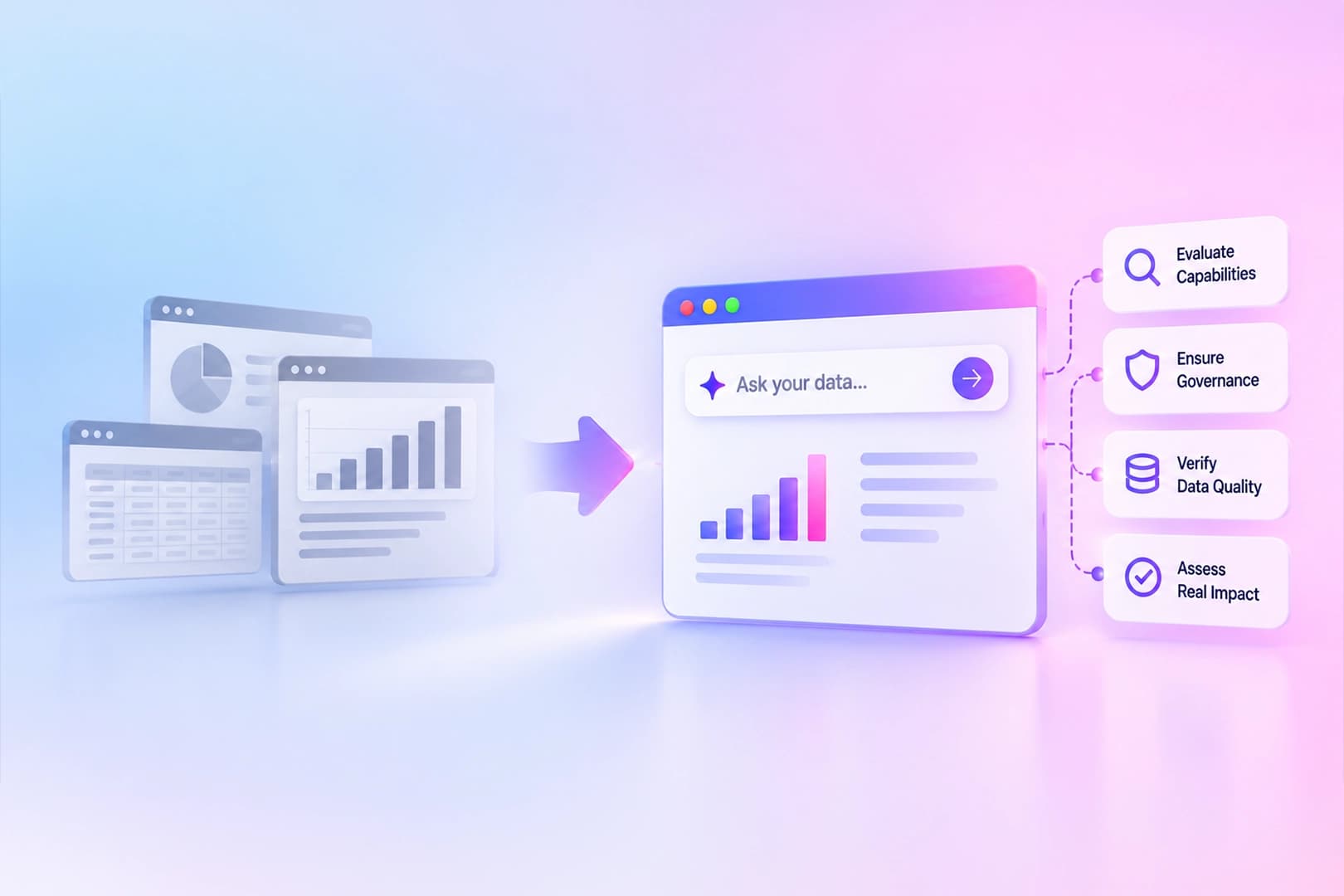
Every AI BI vendor’s homepage says roughly the same four things. Ask questions in plain English. Get instant answers. No more waiting on analysts. Works with any data source. Read ten of these homepages back to back and they start to blur into one page with a different logo at the top.
None of that tells you which one will actually hold up once real business users start asking it real questions. The differences that matter are almost never visible in a demo. They show up three months in, when someone asks a question the demo never covered, or when two people ask the same question and get two different answers, or when someone in compliance asks how a specific number was produced and nobody can say for certain.
Here is what actually separates these tools, past the homepage.
Old BI evaluation criteria don’t fully apply anymore
Traditional BI evaluations focused on things like dashboard build speed, visualization variety, and how many connectors a tool shipped with. Those questions still matter, but they’re no longer sufficient. A tool that answers questions conversationally introduces a new category of risk that dashboard-based BI never had: the tool can now generate a wrong answer that looks exactly as confident as a right one.
A static dashboard can be misread, but it can’t lie to you in a full sentence. A conversational AI layer can. That changes what “evaluation” needs to cover.
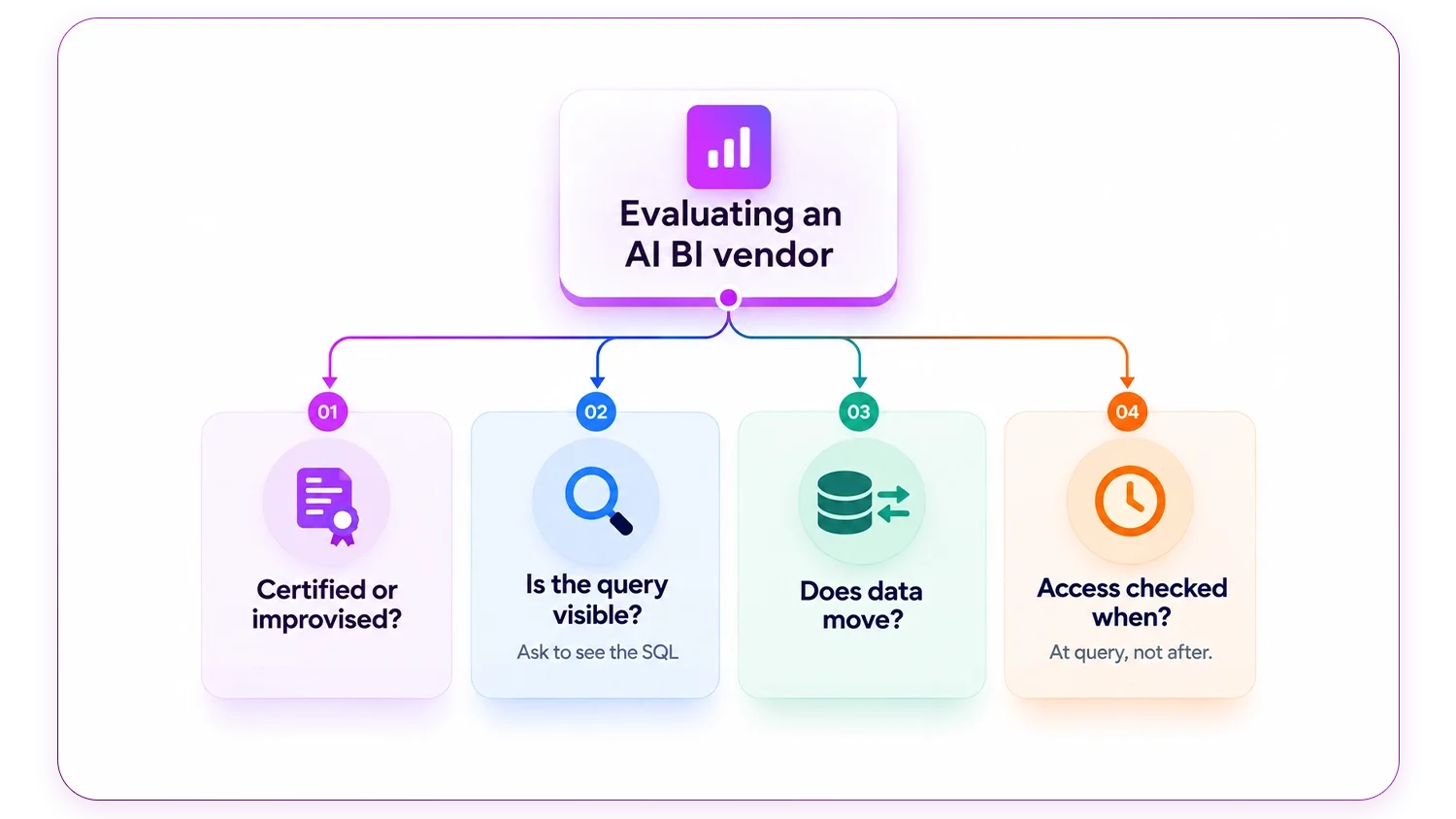
Does it answer from certified definitions, or improvise them?
This is the single most important question, and it’s the one most demos are built to avoid. Ask the vendor directly: when someone asks about a metric that has no formal definition yet, what happens? A tool built around a governed semantic layer will say it can’t answer until that metric is defined, or it will show you exactly which definition it used and let you inspect it. A tool built primarily on a language model’s general reasoning will often generate something plausible anyway, calculated on the fly from whatever it can infer, without telling you that’s what happened.
The second version demos beautifully. It also means two people can ask the identical question a week apart and get two different numbers, because the model quietly re-derived the logic each time.
Can you see the query behind the answer?
Ask for the actual SQL, or whatever query the system generated to produce the answer. Not a summary of the logic, the literal query. If a vendor can’t show you that, or treats it as a power-user feature buried three menus deep, that’s worth noting. The ability to inspect the underlying query is what turns “trust the AI” into “verify the AI,” and only one of those scales past the first few months of skepticism from an audit or finance team.
Does data have to move to get an answer?
Some AI BI tools require pulling your data into their own environment before they can answer anything, a separate copy, a separate pipeline, a new place for that data to live and go stale. Others query your existing warehouse directly, in place, read-only. The difference matters more than it sounds like in a demo, because every extra copy of your data is a new thing to secure, govern, and eventually reconcile against the original.
Ask specifically whether the tool executes against your warehouse or requires ingestion into its own store first. The answer changes your total security surface, not just your architecture diagram.
What happens when it doesn’t know?
Every AI BI tool will eventually be asked something it can’t answer well, a metric that doesn’t exist, a question outside its scope, ambiguous phrasing. What it does at that moment tells you more than almost anything else in the evaluation. Some tools guess anyway and present the guess with full confidence. Others say plainly that the definition doesn’t exist yet, or that the question needs to be narrowed. Push on this specifically during any trial. Ask something you know the tool cannot answer correctly and watch what it does instead of admitting the gap.
Who can ask what?
Self-service only works if access is actually scoped. Ask how permissions are enforced: is access checked at the moment a query runs, or is it enforced by filtering results after the fact, or worse, left to the model to respect on its own. Query-time enforcement means a user literally cannot retrieve data outside their permission, regardless of how the question is phrased. Post-hoc filtering or model-level trust means the boundary is softer than it looks, and softer boundaries tend to fail exactly when someone gets creative with a prompt.
Can you choose your own model, or are you locked to one?
The underlying language model powering these tools changes fast, and today’s best option won’t stay the best option indefinitely. A tool tightly coupled to one specific model ties your governance and your model choice together permanently. A tool that separates the semantic layer from the model itself lets you change models as the market moves without rebuilding your certified definitions from scratch.
The red flags that sound good in a demo
A few things worth specific suspicion, because they tend to demo well and hold up poorly: a tool that never says “I don’t know,” a tool where every answer looks equally confident regardless of how well-supported it actually is, a tool that can’t show you its own reasoning path when asked directly, and a tool where the sales team can’t clearly explain what happens to a question outside its trained scope.
None of these are dealbreakers on their own. All of them together usually mean the tool was built to impress in a thirty-minute demo, not to survive daily use by people who will eventually ask it something it wasn’t ready for.
What actually matters
The vendors selling AI BI are not lying when they say it’s faster than a dashboard. It usually is. The real evaluation question isn’t speed, every tool in this category is fast now. It’s whether the speed is coming from a governed, certified answer or from a model’s best guess dressed up to look certain. One of those scales safely as more people start relying on it. The other one accumulates risk quietly, one plausible-sounding answer at a time, until someone finally asks where a number came from and nobody can say.