
A data analyst at a mid-size logistics company spent forty minutes on a Tuesday afternoon reconstructing a churn number from scratch. Not because the number didn’t exist anywhere. Because someone in sales had already pulled a number from a public chatbot, brought it into a leadership meeting that morning, and now the analyst had to prove it right or wrong before anyone would trust either version.
The number turned out to be close, but built on a customer segment definition that didn’t match what finance used. Nobody in that meeting knew that. They just knew there were now two churn numbers in the building, and someone had to lose the argument about which one was real.
This is the actual cost of shadow AI, and it rarely shows up in the way risk conversations describe it.
The tax isn’t where most people are looking
Most discussion of ungoverned AI use frames it as a security problem: sensitive data pasted into a public chatbot, sitting somewhere outside the company’s control. That risk is real. It is also not where the recurring cost lives.
The recurring cost lives downstream, on the data team, every time an ungoverned answer reenters the business as if it were a governed one. Someone asked a chatbot a question, got a plausible number, and used it. The data team didn’t produce that number and usually doesn’t find out it exists until it conflicts with something they did produce. At that point, the work isn’t optional. Someone has to figure out where the number came from, what it means, and why it doesn’t match, before the disagreement can even be resolved, let alone closed.
That work is a tax. It gets paid every time it happens, and almost nobody is tracking the total.
What the tax actually looks like
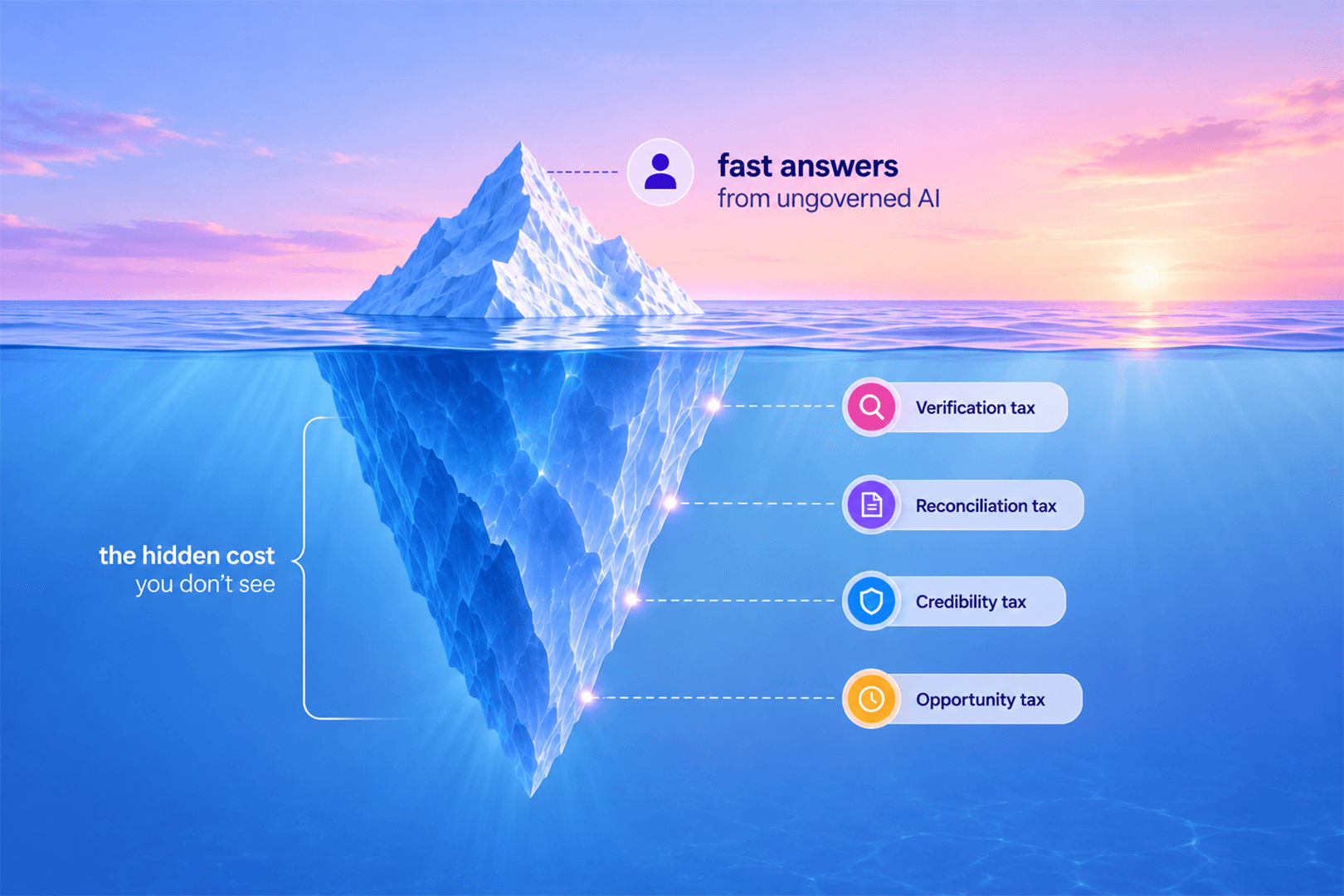
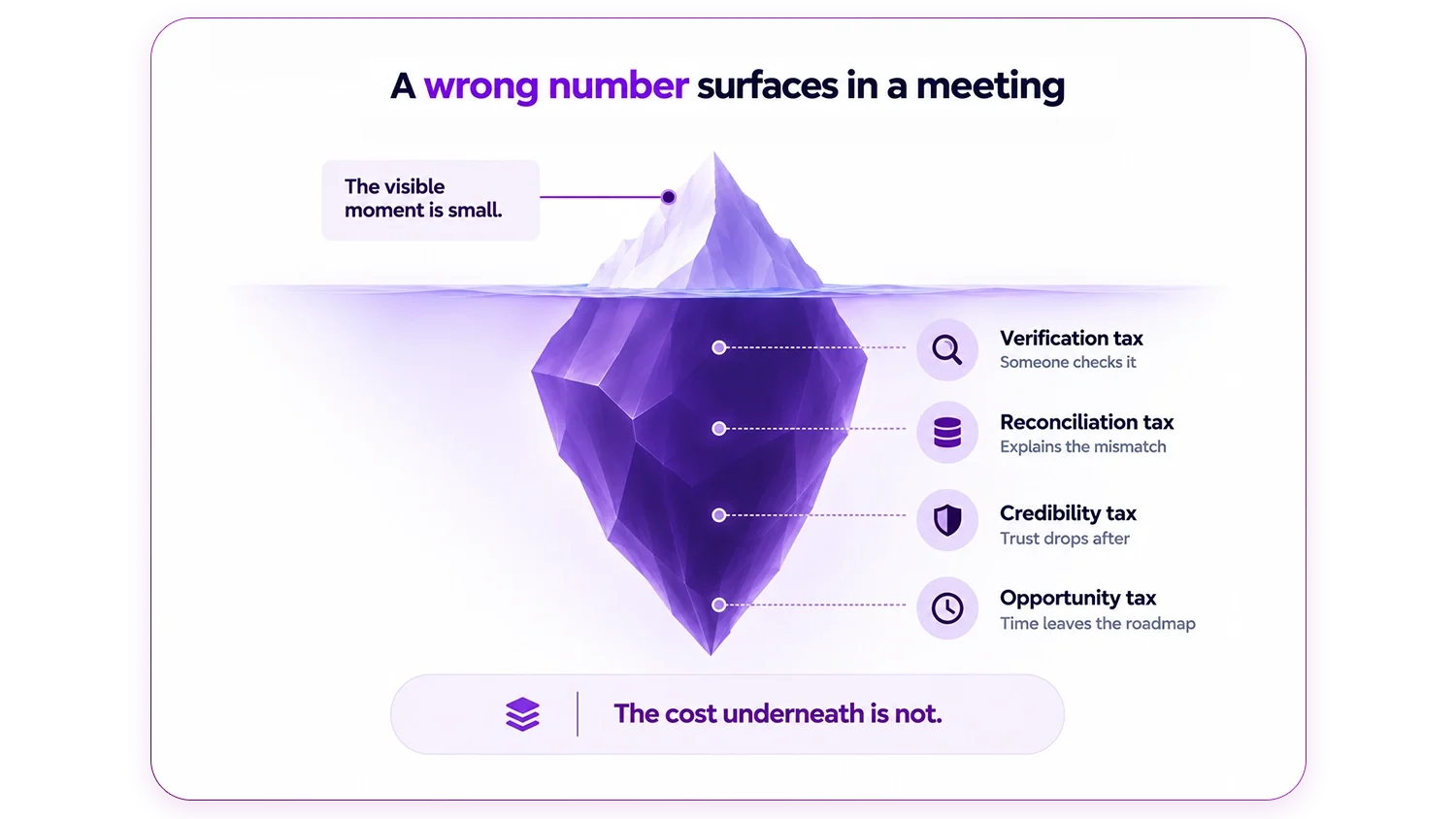
The verification tax. Every ungoverned number that reaches a meeting eventually needs someone to check it. That checking work rarely gets scheduled. It gets absorbed, usually by whoever is already stretched thin, at the exact moment a decision is waiting on the answer.
The reconciliation tax. Two numbers in a room means someone has to explain the gap. That explanation almost never has a quick answer, because the gap is usually a definitional mismatch: a different date range, a different customer segment, a different join that nobody wrote down. Resolving it means reverse engineering a query nobody kept a record of.
The credibility tax. Once a wrong number has been in a meeting, the data team’s numbers get a second look too, even the correct ones. Trust doesn’t erode evenly. One bad number from an ungoverned source can quietly increase scrutiny on everything the data team produces afterward, whether that scrutiny is warranted or not.
The opportunity tax. All of that verification and reconciliation time comes from somewhere. It comes from the roadmap, the actual analysis work the data team was supposed to be doing instead of playing defense against an answer they didn’t produce.
None of these show up on a dashboard. They show up as a data team that seems perpetually behind, without anyone being able to point to exactly why.
Banning the tool doesn’t remove the tax
The instinctive response to this is to block public AI tools at the network level and call the problem solved. It rarely works, and when it does work, it usually just moves the cost somewhere less visible. The underlying need, a fast answer to a specific business question, does not go away because the tool got blocked. It moves to a personal device, a different account, a colleague who still has access. The tax stays the same. The visibility into it gets worse.
Blocking access without offering a governed alternative treats the symptom and leaves the actual cause in place: business users have a real question and no fast, trustworthy way to ask it.
What actually removes the tax
The only way to remove the verification and reconciliation tax is to remove the reason it exists: a governed answer has to be at least as fast as an ungoverned one, or the ungoverned path stays attractive no matter what the policy says.
That means conversational access to data that resolves through certified definitions instead of a model’s best guess. When gross margin means the same thing everywhere it’s asked, and the answer comes with a citation back to the source table and the definition version behind it, there is nothing left to reconcile. The number that shows up in the meeting is the number the data team would have produced anyway, because it came from the same governed pipeline.
It also means every question leaves a prompt-level record: who asked, what was resolved, what ran, what came back. When a number is challenged, the answer to “where did this come from” is a lookup, not an investigation.
This is not a security control bolted onto an existing BI stack. It is what removes the actual incentive for the shadow path to exist in the first place, because the sanctioned path stops being slower.
The real question to ask
The shadow AI tax rarely gets calculated directly, because it is spread across dozens of small interruptions rather than one visible incident. A more useful exercise than trying to measure it after the fact is asking the data team a simpler question: how many hours this month went toward verifying, reconciling, or explaining a number that didn’t originate with them?
Whatever that number turns out to be, it is not a cost the business decided to pay. It is a cost that accumulated because the sanctioned path was slower than the alternative. Fixing that gap is what actually stops the tax from being collected again next month.