
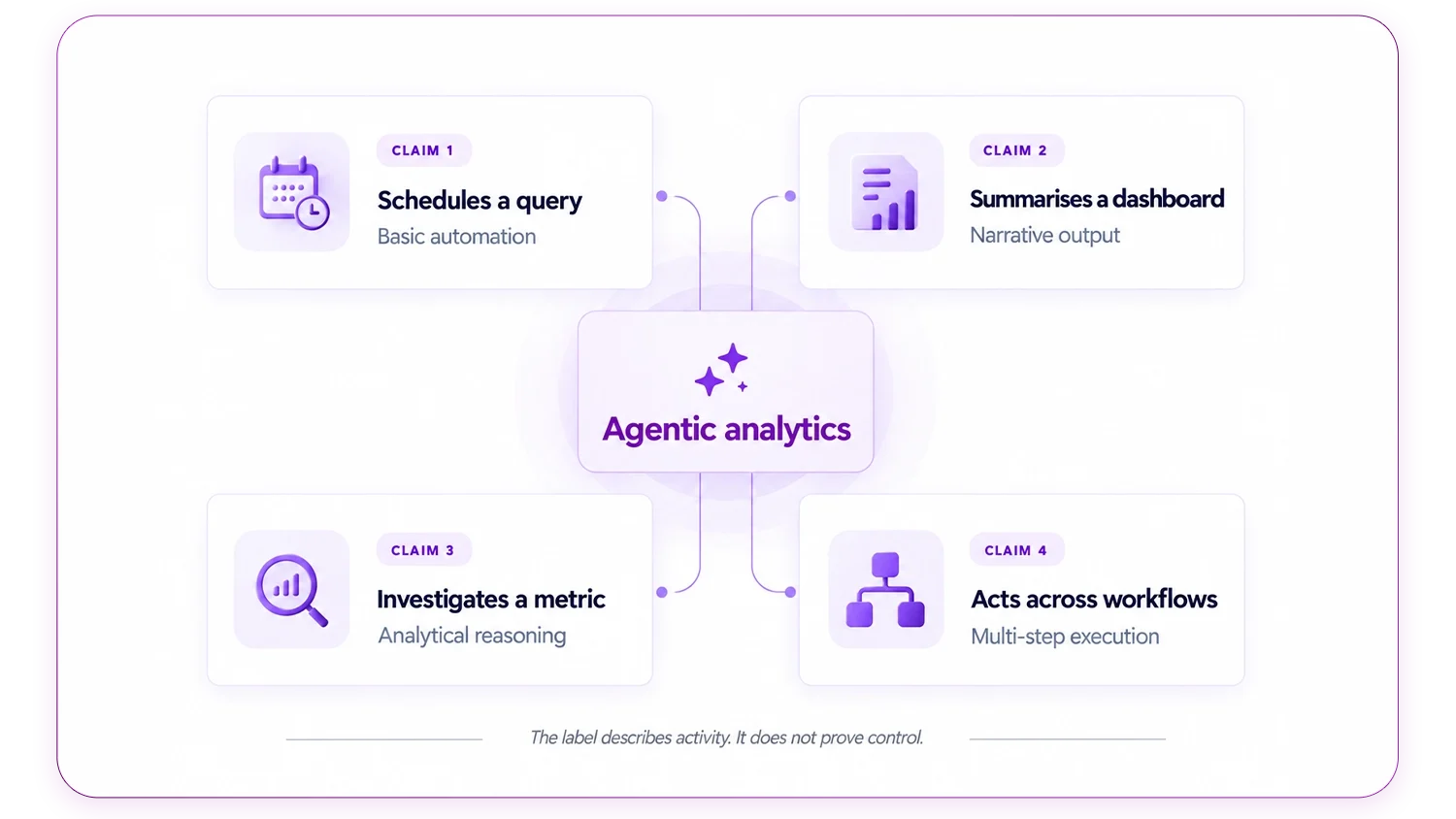
Agentic is the most borrowed word in analytics right now. Every vendor deck has it. Every product launch claims it. Strip away the label and ask what the software actually does, and the answers vary wildly: some tools schedule a query, some summarise a dashboard, some genuinely plan and execute multi-step analytical work on their own. The word has expanded to cover all of it, which means the word on its own now tells a buyer almost nothing.
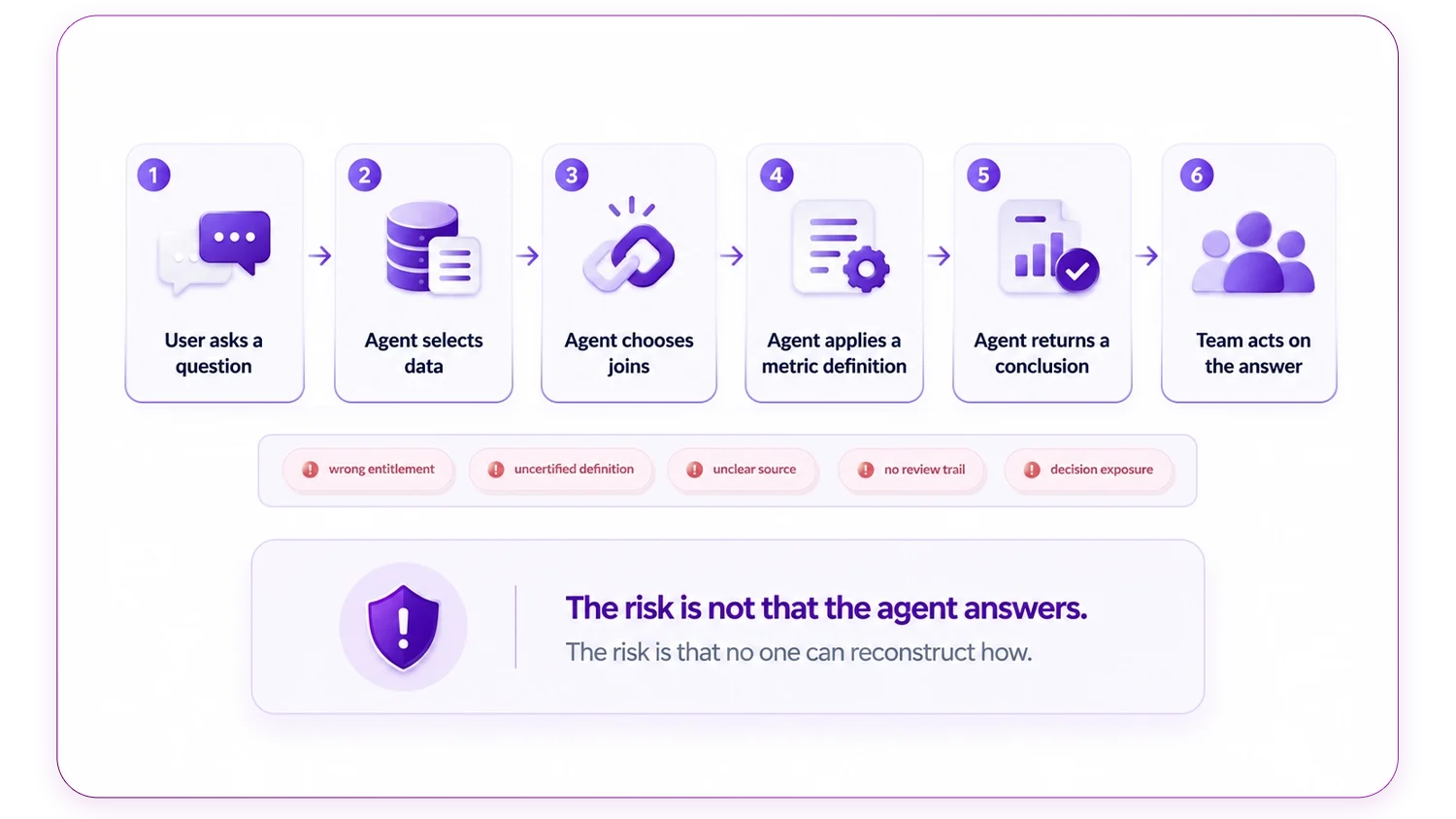
That would be a harmless marketing problem if agents were harmless software. They are not. An agent is software that acts. It decides which data to touch, which joins to run, which conclusions to surface, and in some deployments, which follow-up actions to trigger. The moment software acts on enterprise data, the questions that matter stop being about intelligence and start being about control. Who authorised this agent to see this table? What definition of revenue did it use? Can anyone reconstruct why it gave the answer it gave? An agent without answers to those questions is not an analytics capability. It is an unmanaged actor inside your data estate.
Autonomy without accountability is the old problem in new packaging
Enterprises have seen this shape of problem before. Shadow IT was the last decade’s version: useful tools adopted faster than they could be governed, producing convenience in the short term and audit findings in the long term. Ungoverned agents repeat the pattern with higher stakes, because the tool is no longer a spreadsheet on someone’s desktop. It is an autonomous process with query access to production data, generating answers that executives act on.
The failure modes are predictable. An agent trained on nothing but the raw schema invents a definition of churn that no finance team would sign off on. Two agents in two departments compute the same metric differently, and both answers travel upward into board materials. A well-meaning analyst asks a question that touches restricted data, and the agent, having no concept of role-based access, answers it. None of these are exotic edge cases. They are the default behaviour of autonomous systems that were never given rules.
What governance actually means for an agent
Governance is often heard as a synonym for slowness, a compliance layer that sits between people and their answers. Applied to agents, it means something more precise and more useful. It means the agent operates inside a defined boundary, and every step it takes leaves a record.
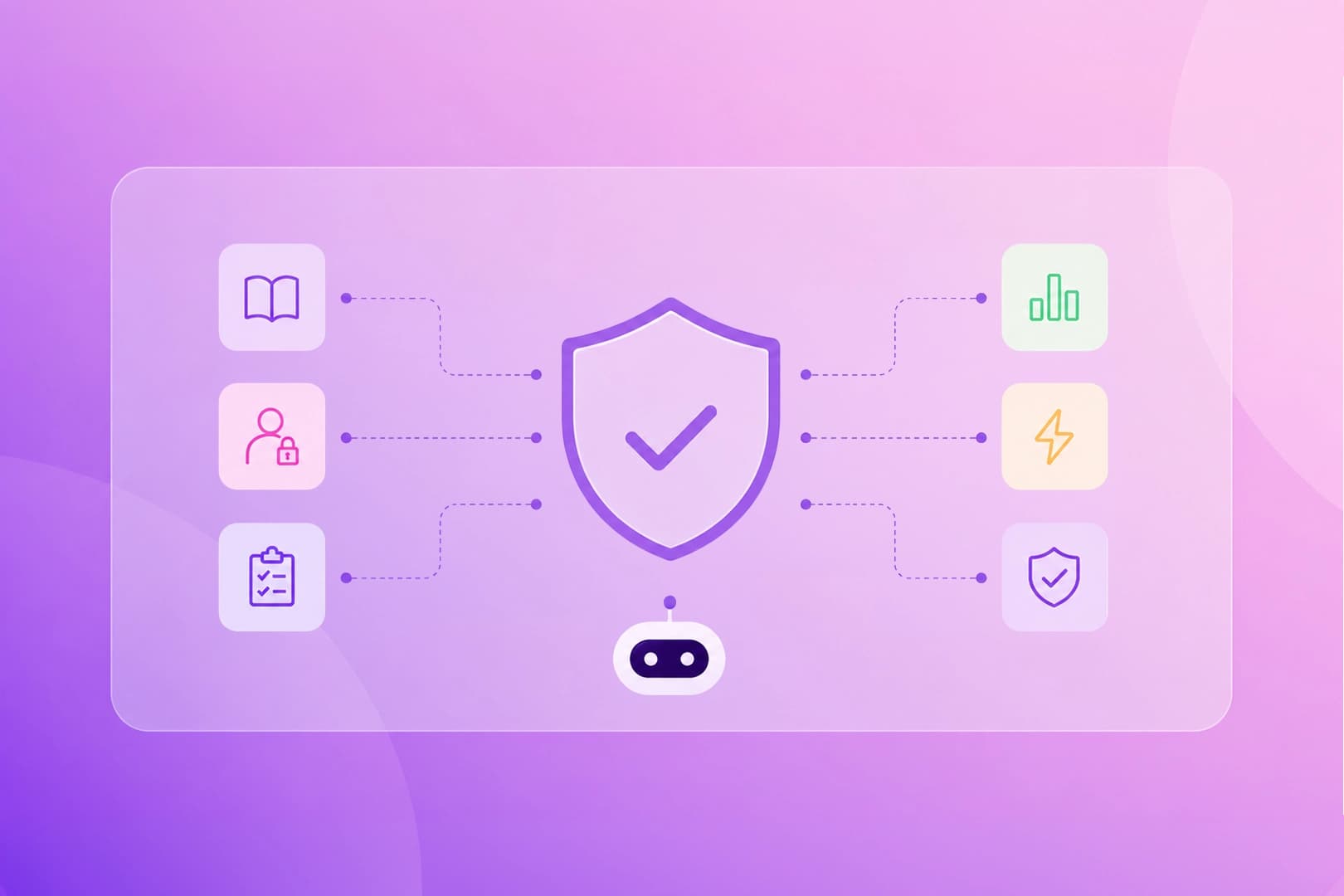
In practice, that requires three things. First, certified definitions: the agent draws its understanding of metrics from a semantic layer that the business has approved, so “gross margin” means the same thing in every answer, in every department, every time. Second, access control at the moment of the query: the agent inherits the permissions of the person asking, not a superuser’s view of the warehouse, so a regional manager’s question is answered with regional manager’s data. Third, a complete audit trail: the prompt, the generated SQL, the tables touched, and the result, all logged and reviewable, so any answer can be reconstructed and defended months later.
With those three in place, autonomy stops being a risk to contain and becomes a capability to deploy. Without them, every additional degree of agent autonomy is an additional degree of exposure.
The market will sort vendors on this line
Regulated industries will draw the line first, because their auditors and regulators will draw it for them. A bank, an insurer, or a health system cannot deploy software that acts on data and cannot explain itself. Procurement teams in these industries are already adding questions about lineage, logging, and model provenance to their evaluation checklists, and vendors whose agents cannot answer will not survive the RFP stage regardless of how capable the underlying model is.
The rest of the market will follow, for a simpler reason: trust compounds. Based on QuaerisAI customer deployments and published materials, organisations that deploy governed agents see BI adoption rates of 30 to 60 percent, well above the levels most enterprises achieve with dashboard-first tooling. Adoption follows trust, and trust follows the ability to check the work. People use tools whose answers they can verify. They quietly stop using tools whose answers they cannot.
The category is Governed Agentic Analytics, not agentic analytics
The distinction is not pedantic. Agentic describes what the software can do. Governed describes whether an enterprise can actually let it do those things. A platform that offers the first without the second is offering a demo, not a deployment. The buyers who understand this earliest, chief data officers, CISOs, and heads of compliance in regulated industries, are the ones writing the requirements the whole category will eventually meet.
Agentic is the adjective vendors chose. Governed is the adjective enterprises will insist on.
Frequently asked questions
What is the difference between agentic analytics and governed agentic analytics?
Agentic analytics refers to autonomous AI agents that plan and execute analytical tasks, such as writing queries, investigating anomalies, and assembling answers across sources. Governed agentic analytics adds the enterprise control layer: certified metric definitions from a semantic layer, role-based access enforced at query time, and a full audit trail from prompt to SQL to result. The first describes capability. The second describes deployability.
Why is governance harder for agents than for dashboards?
A dashboard is a fixed artefact. It was built once, reviewed once, and shows the same certified numbers to everyone with access. An agent generates new analysis on demand, which means every answer is a new artefact that has never been reviewed by a human. Governance therefore has to move from review-before-publish to controls-at-runtime: approved definitions, enforced permissions, and automatic logging on every single query.
Does governance slow agents down?
Properly architected, no. Governance controls in a platform like QuaerisAI operate at query time as part of how the answer is produced, not as a separate approval step a human must complete. The semantic layer resolves definitions in the same pass that generates the SQL, and logging happens automatically. The user experience is a direct question and a direct answer, with the accountability built underneath rather than bolted in front.