
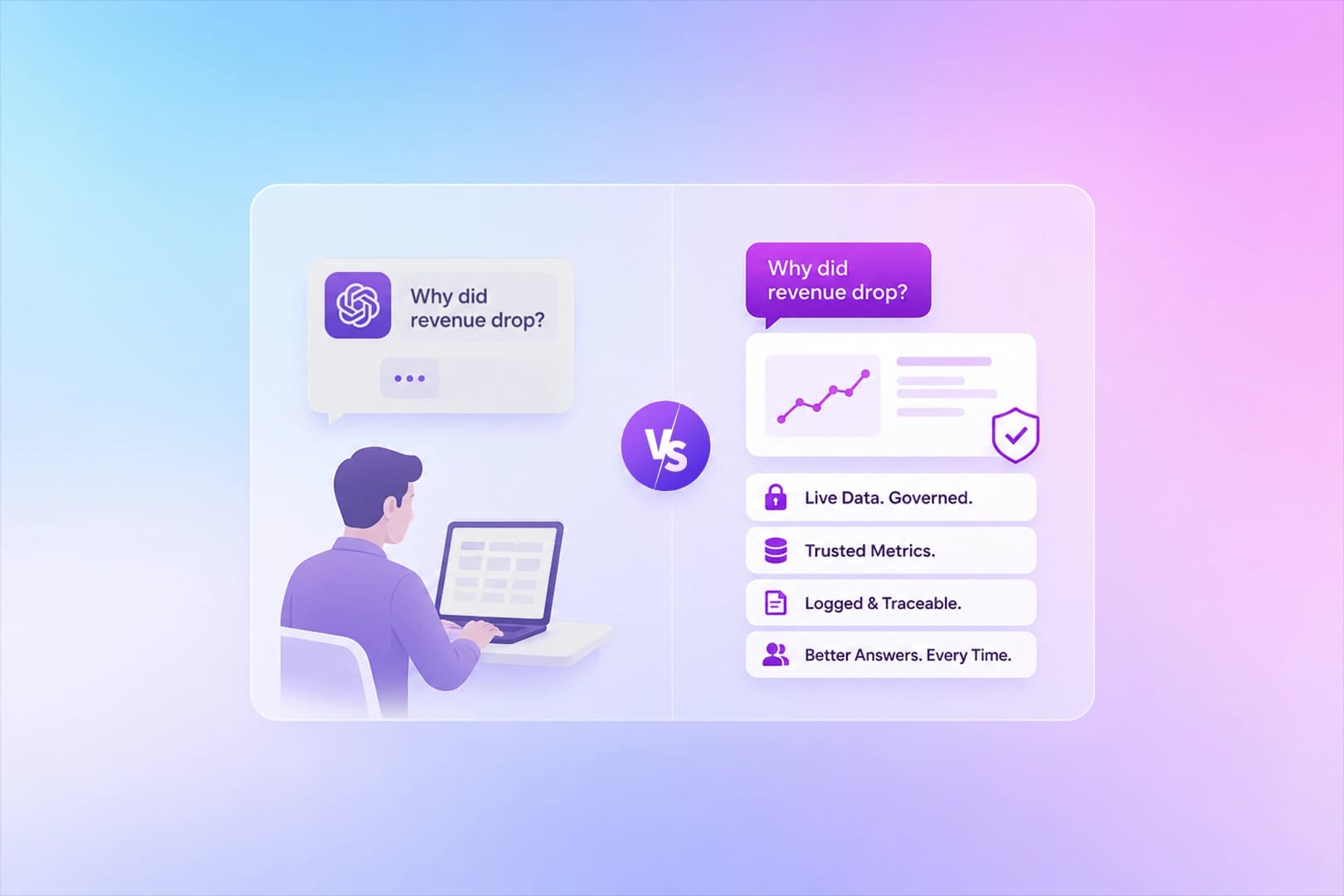
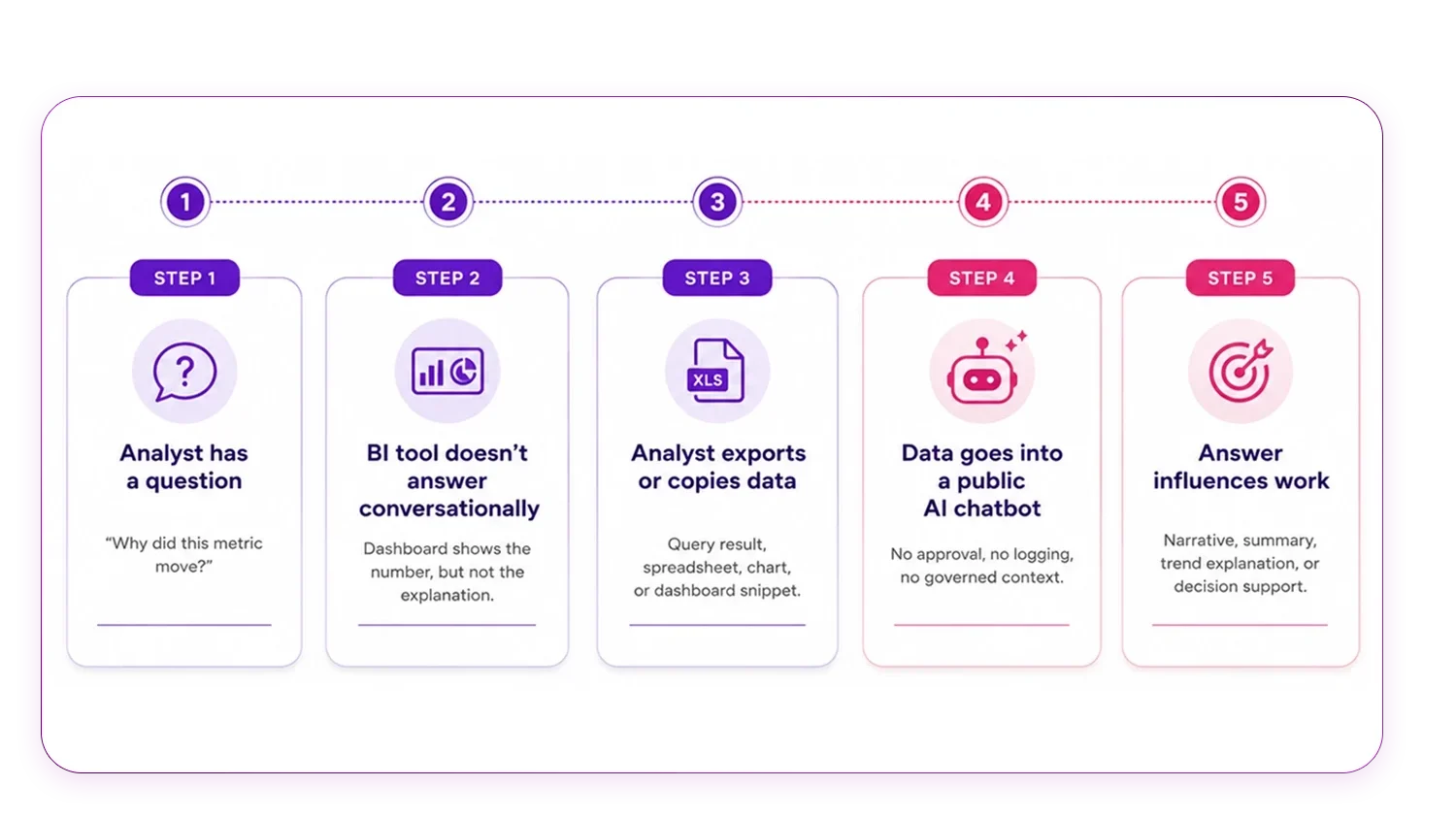
Somewhere in your organisation this week, an analyst copied query results out of the warehouse, pasted them into a public AI chatbot, and asked it to explain the trend. Nobody approved this. Nobody logged it. The analyst was not being reckless; they were being rational. They had a question, the sanctioned BI stack could not answer it conversationally, and a free tool in a browser tab could. That single act, multiplied across every data-literate employee with a deadline, is the shadow-AI problem, and it is the direct descendant of every shadow-IT wave that came before it.
Shadow AI is a demand signal wearing a risk costume
The instinctive response is enforcement: block the domains, update the acceptable-use policy, remind everyone in the next security training. This treats the behaviour as a discipline problem, and it misreads what is actually happening. Employees route around sanctioned tools when the sanctioned tools fail them, and the failure here is specific. Dashboards answer the questions someone anticipated when the dashboard was built. The questions people actually have, why did this number move, what is different about this cohort, which of these explanations holds up, are conversational and investigative. Public chatbots handle exactly that interaction, so the work flows to them. Shadow AI is what unmet demand for conversational analytics looks like in the wild. The demand is the valuable information. The routing is the problem.
What the organisation loses on every shadow query
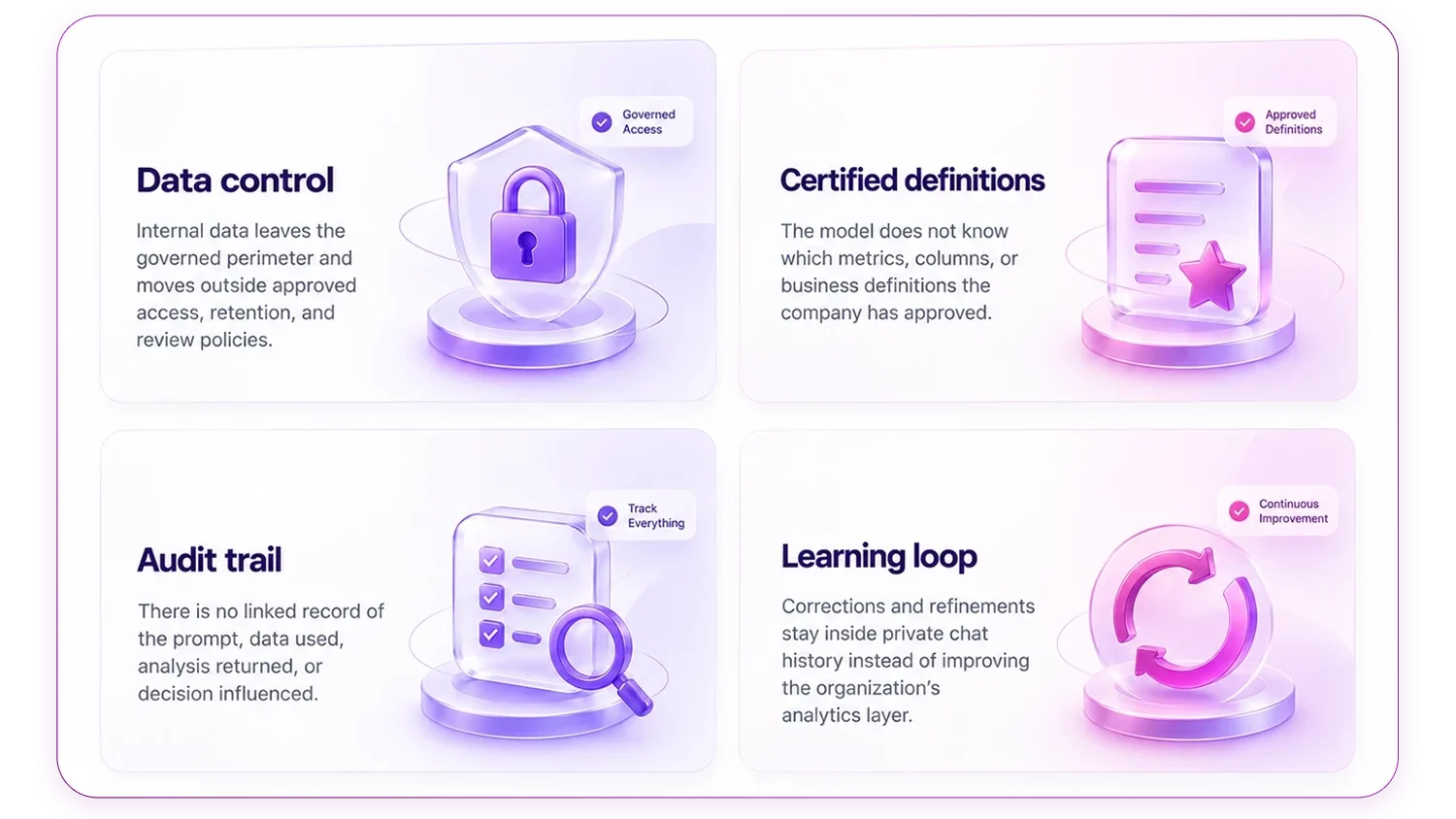
The obvious loss is data control. Enterprise data pasted into a consumer chatbot has left the governed perimeter, outside the organization’s access controls, retention policies, and, depending on the tool’s terms, potentially into a vendor’s systems under conditions no one reviewed.
For regulated data, that can constitute a reportable incident on its own. But the quieter losses compound just as badly. The answer the analyst receives is ungrounded: a general-purpose model with no knowledge of the company’s certified metric definitions is guessing at what the columns mean, and its confident narrative may rest on a misreading no one will catch. The interaction is unlogged, so the analysis that later influences a decision has no lineage at all. And the correction loop is severed: when the analyst refines the question or fixes the model’s misunderstanding, that learning evaporates into a private chat history instead of improving anything the organization owns.
Why prohibition alone has never won this fight
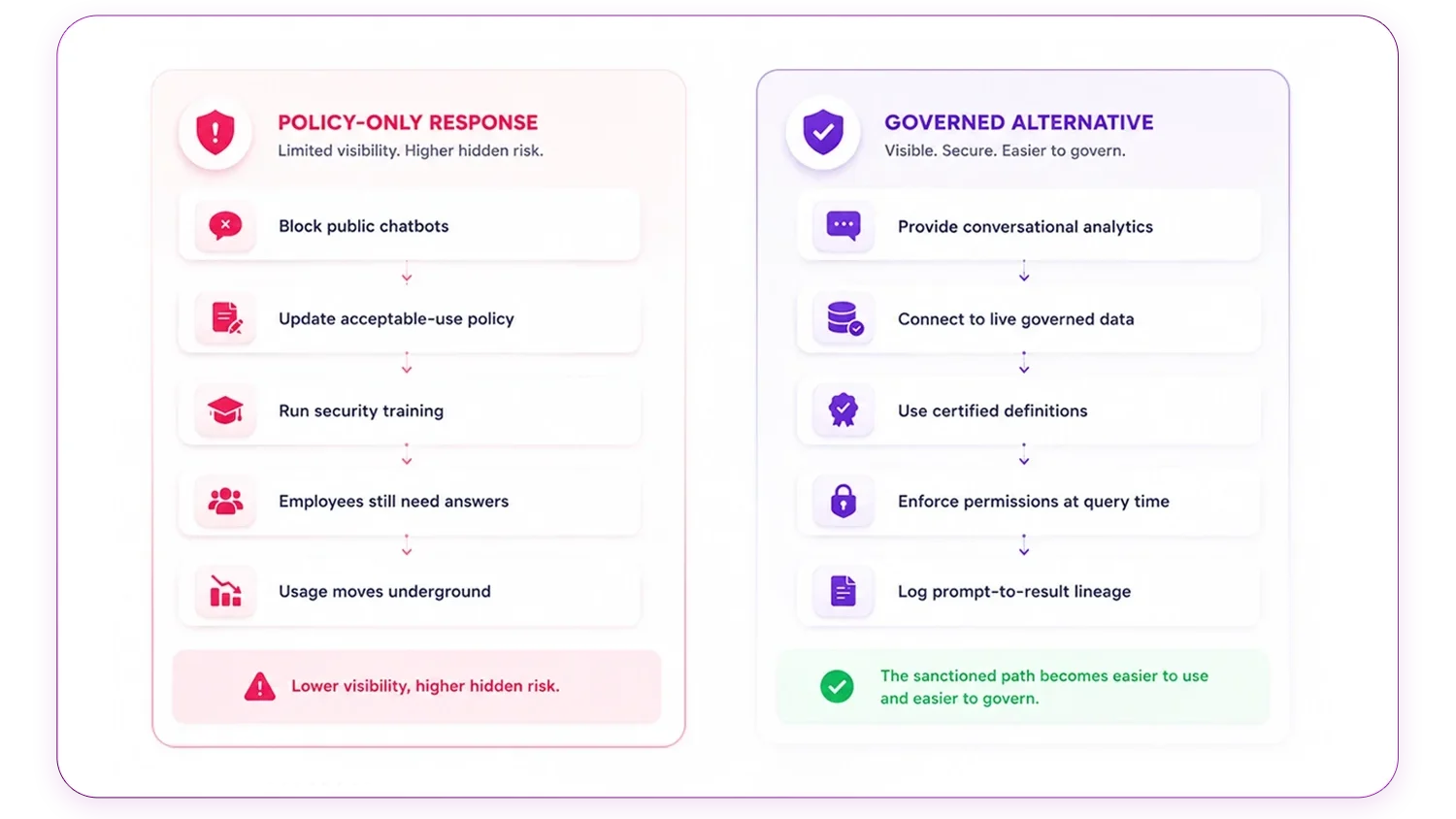
Shadow IT history is unambiguous on this point. Unsanctioned file sharing was not defeated by blocking consumer storage sites; it ended when enterprises deployed sanctioned tools that were as easy to use. Personal devices were not banished from corporate email; they were brought under management. In every case, the resolution was the same: match the convenience, add the controls. Prohibition without a sanctioned alternative does not stop the behaviour. It selects for the employees most willing to hide it, which makes the risk less visible and therefore worse. An organisation that blocks public chatbots while offering nothing conversational in return has not closed the gap. It has pushed the gap underground.
The sanctioned path has to win on convenience, not just on policy
The durable fix is to give analysts a conversational interface that is better than the shadow option on the merits, not merely compliant. Better here has a precise meaning. The sanctioned tool answers in the same conversational register, but against live warehouse data rather than a pasted fragment, so the analyst stops doing the copy-and-paste work at all. Its answers resolve against certified definitions from a semantic layer, so “gross margin” means what finance says it means, which a public chatbot can never know. Permissions are enforced at query time, so the tool is usable on sensitive data instead of being quarantined from it. Every interaction is logged prompt-to-result, so the analysis has lineage. And corrections feed back into the platform’s semantic understanding, so each analyst’s refinement improves the next analyst’s answer instead of vanishing.
When the governed option clears the convenience bar, usage moves, and it moves measurably. Based on QuaerisAI customer deployments and published materials, one enterprise deployment alongside Power BI produced a 400 percent lift in data interaction: questions that previously went unasked, or went to shadow channels, arriving through a governed interface instead. That is the shadow-AI problem solving itself in the only way it ever durably does, by making the sanctioned path the path of least resistance.
Treat the shadow queries as your requirements document
For data leaders, the practical move is to stop reading shadow-AI activity purely as a violation and start reading it as free product research. The questions employees take to public chatbots are a precise map of what the current BI estate cannot do: which investigations people need, which metrics confuse them, where dashboards end and real questions begin. An organisation that answers that map with a governed conversational platform converts its riskiest behaviour into its adoption case. One that answers with policy memos alone will be writing the same memo again next year.
Frequently asked questions
What is shadow AI?
Shadow AI is the use of AI tools, most commonly public chatbots, for work tasks without organisational approval, oversight, or logging. In analytics it typically looks like employees pasting internal data or query results into a consumer AI tool to get explanations, summaries, or analysis the sanctioned BI stack does not provide conversationally.
Is shadow AI riskier than earlier shadow IT?
In one important respect, yes. Earlier shadow IT mostly moved files; shadow AI moves data into systems that generate confident analytical claims about it. The organisation is exposed twice: once when the data leaves the governed perimeter, and again when an ungrounded, unlogged answer flows back in and influences a decision. The second exposure is harder to detect because the artefact it produces looks like ordinary analysis.
Should organisations block public AI chatbots entirely?
Blocking can be a reasonable interim control for sensitive data, but it is not a solution on its own, because it addresses the routing without addressing the demand. The pattern that has worked across every shadow-IT wave is pairing the control with a sanctioned alternative that matches the convenience of the shadow tool. Policy sets the boundary; the governed alternative is what actually moves the behaviour.