
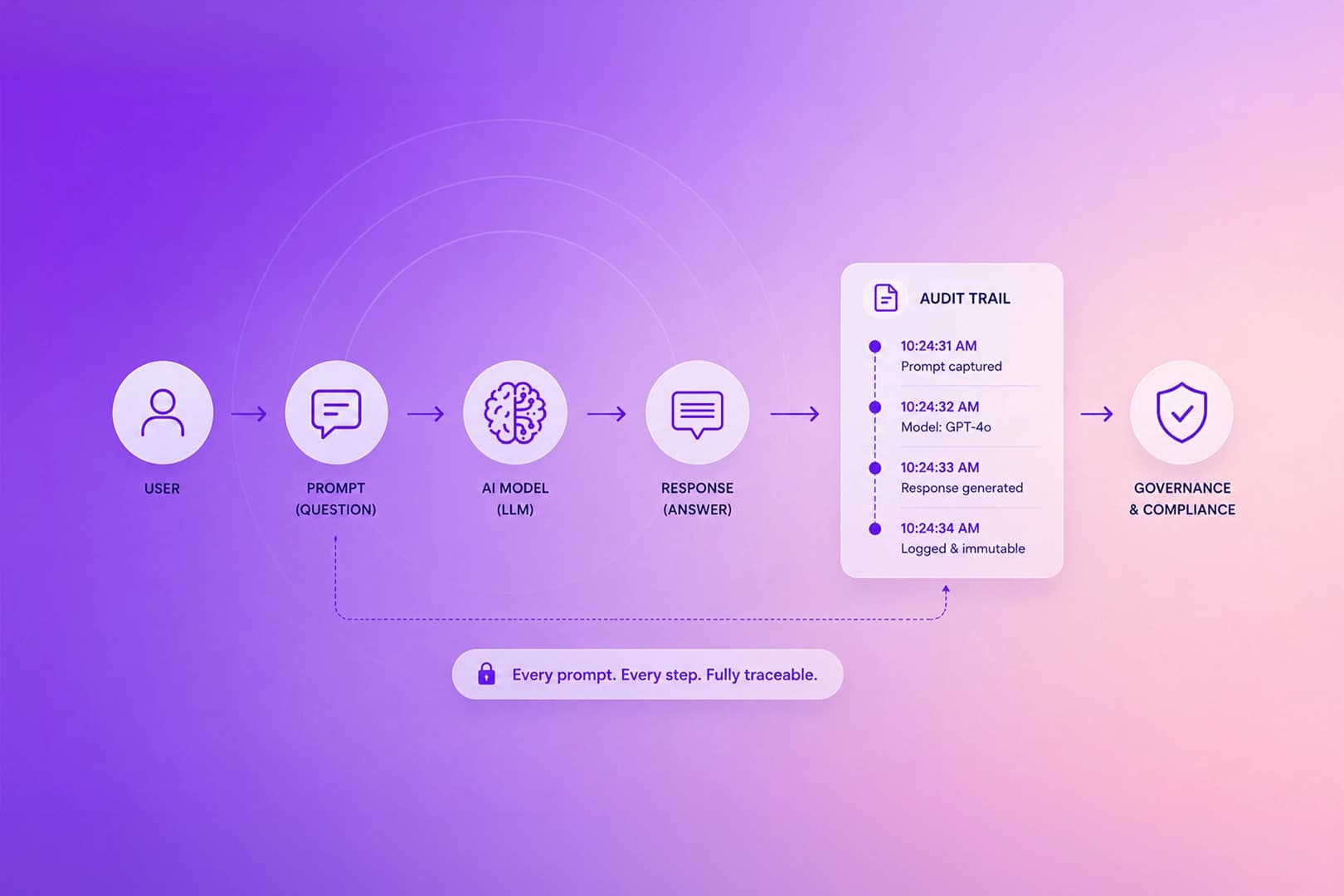
Picture an internal auditor in 2027 reviewing how a critical business decision was made. The decision rested on a number, and the number came from an AI agent. The auditor asks the obvious questions. Who asked for this analysis? What exactly did they ask? What query did the system run? Which data did it read? Which model reasoned over it? For most AI analytics deployments today, the honest answer to all five questions is the same: we don’t know. The answer appeared in a chat window, the chat was cleared, and the chain of evidence never existed.
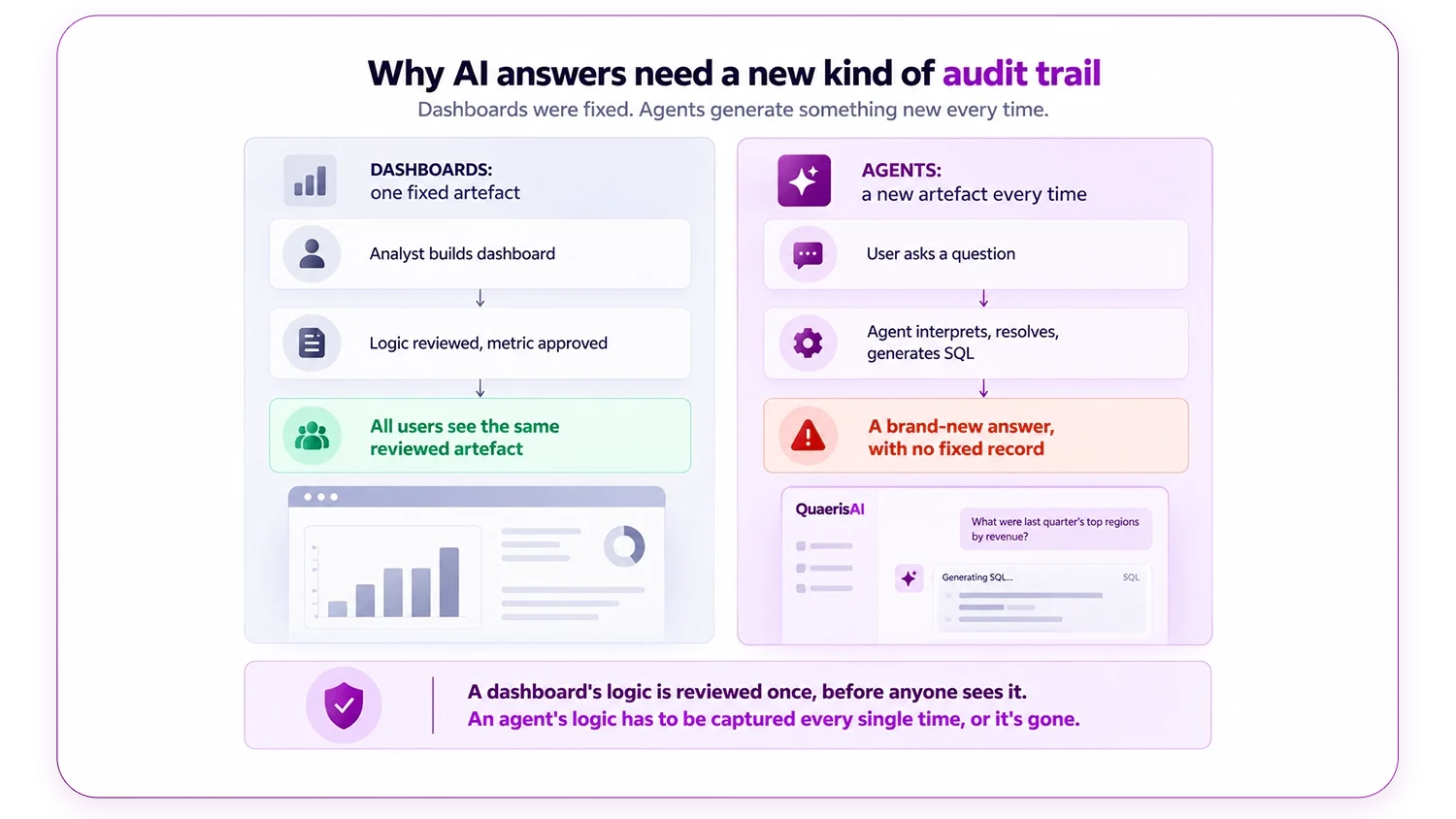
Dashboards never had this problem, because dashboards never generated anything. A dashboard is a reviewed artefact: someone built it, someone approved it, and its logic sits in version control. Agentic analytics breaks that model. Every answer an agent produces is a new, never-before-reviewed piece of analysis, generated at the moment of asking. If enterprises are going to run on answers generated this way, and they are, then the review has to move from before publication to after the fact, and after-the-fact review requires a record. That record is the prompt-level audit trail.
What a prompt-level audit trail contains
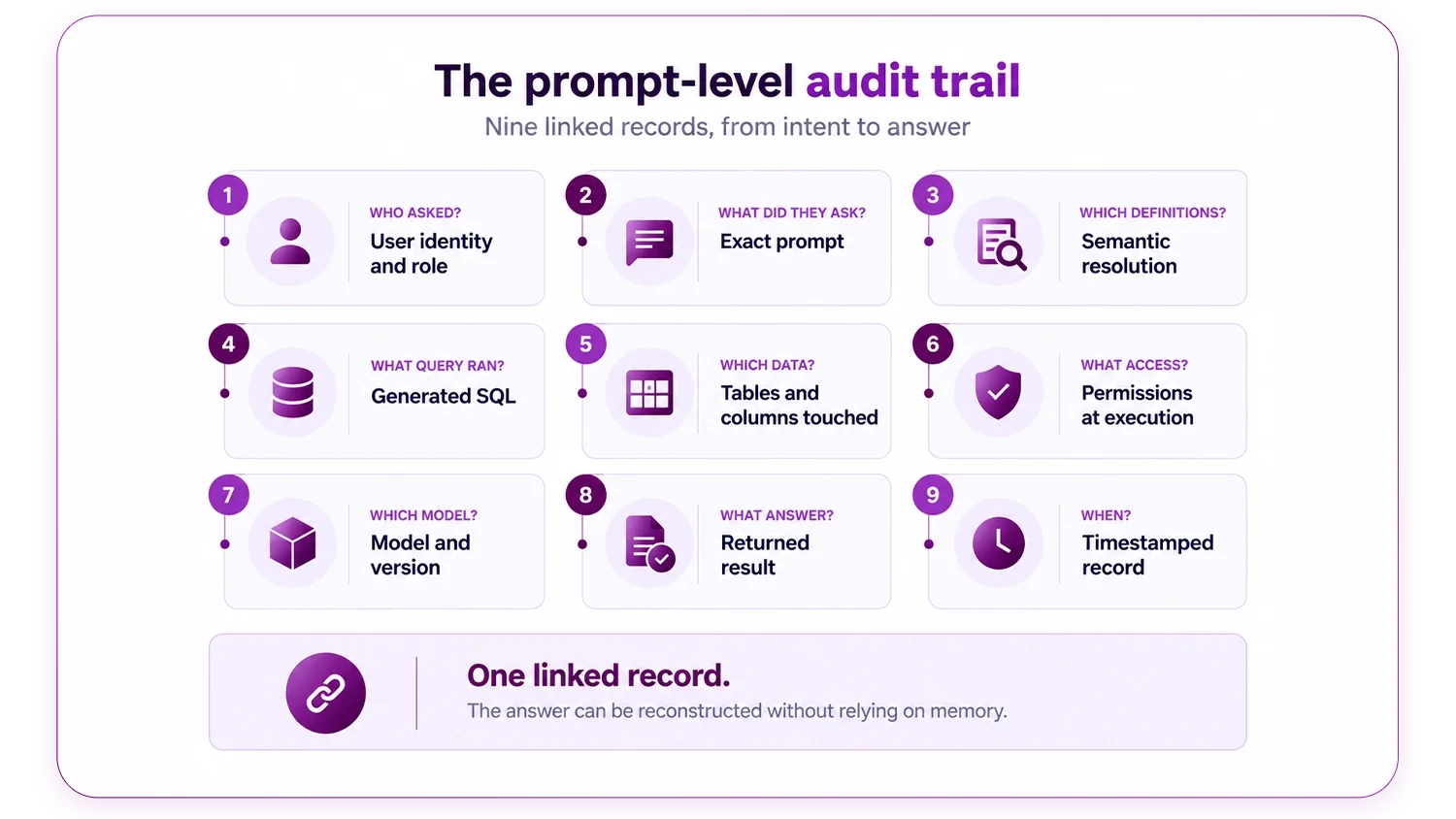
The name is precise. The trail begins at the prompt, not at the query, because the prompt is where intent lives and where accountability starts. A complete trail captures the identity and role of the person asking, the exact wording of their question, the semantic definitions the platform resolved that question against, the SQL the agent generated, the tables and columns that SQL touched, the access permissions in force at the moment of execution, the model that produced the reasoning and its version, the result returned, and the timestamp of every step.
Captured together, these fields make any answer reconstructible. Six months after the fact, a reviewer can replay the entire chain: this person, with these permissions, asked this question, which resolved to these certified definitions, which produced this SQL, which read these tables, which returned this number. Nothing in the chain depends on anyone’s memory. That is the standard evidence has always been held to everywhere else in the enterprise, and there is no reason AI-generated analysis should be exempt.
Why the requirement is arriving now
Three forces are converging on the same demand. Regulators are the first. Frameworks emerging around AI in the EU, in US state legislation, and in sector rules for insurance and healthcare differ in scope and timing, but they share a common thread: organisations deploying AI in consequential decisions must be able to document and explain what the system did. Documentation requires logs. Logs of AI-generated analysis are, by definition, prompt-level audit trails. Specific obligations and enforcement dates vary by jurisdiction and continue to shift, so legal teams should confirm current requirements, but the direction of travel is uniform.
Auditors are the second force. External audit firms are extending their testing to cover AI-assisted processes at their clients, and an AI system whose outputs cannot be traced is an AI system whose outputs cannot be relied upon in an audit. The third force is internal, and it may be the strongest: executives are increasingly unwilling to carry numbers into board meetings that no one can stand behind. The first time a CFO is asked “where did this figure come from” and the answer is “an AI produced it, and we cannot show how,” the organisation acquires a prompt-level audit trail requirement regardless of what any regulator says.
What the trail makes possible
Compliance is the mandate, but it is not the only return. A complete trail is also the mechanism for disproving hallucination claims: when a stakeholder challenges an answer, the SQL and source tables are right there, and the dispute resolves on evidence in minutes rather than on reputation over weeks. It is a quality feedback loop: reviewing trails reveals where users phrase questions the semantic layer handles poorly, which is exactly the signal needed to improve it. And it is an adoption asset. People trust tools whose work they can check. Based on QuaerisAI customer deployments and published materials, governed deployments where every answer is traceable achieve BI adoption rates of 30 to 60 percent, and trust in the answer is a large part of why.
Retrofit is not a strategy
The tempting position is to deploy agents now and add logging when a regulator or auditor asks. This fails for an architectural reason. A trail that captures the prompt, the semantic resolution, the permission check, and the generated SQL as one linked record can only be produced by a platform in which those steps are one pipeline. Bolting a logger onto a system that was not built this way yields fragments: a chat log here, a database query log there, with no reliable join between them. The auditor’s question is not “do you have logs.” It is “can you show me the chain.” Chains are built in, or they do not exist.
The prompt-level audit trail is on its way to becoming what SOC 2 became for SaaS: a requirement no serious buyer waives. The enterprises adopting it now are not doing extra work. They are doing the work once, before it becomes urgent.
Frequently asked questions
How is a prompt-level audit trail different from standard database query logging?
Database logs capture what SQL ran and when. They do not capture who asked the business question, what they actually asked, how the question was interpreted against certified definitions, or which model generated the query. A prompt-level audit trail links the entire chain from human intent to returned result in one record. Query logs are one field within it, not a substitute for it.
How long should prompt-level audit records be retained?
Retention should follow the same schedule the organisation applies to the underlying business records the analysis supports, which varies by industry and jurisdiction. Financial analysis feeding reported results typically inherits multi-year retention obligations. The safe default is to align AI audit records with the retention class of the decisions they informed, and to confirm the specifics with compliance counsel.
Does capturing prompts create a privacy problem?
It creates a privacy design requirement, which is manageable. Prompts are user-generated content and should be handled under the same access controls as the data they touch: audit records themselves should be role-restricted, and access to them should be logged. A governed platform applies the same permission model to reading the trail as to querying the data.