
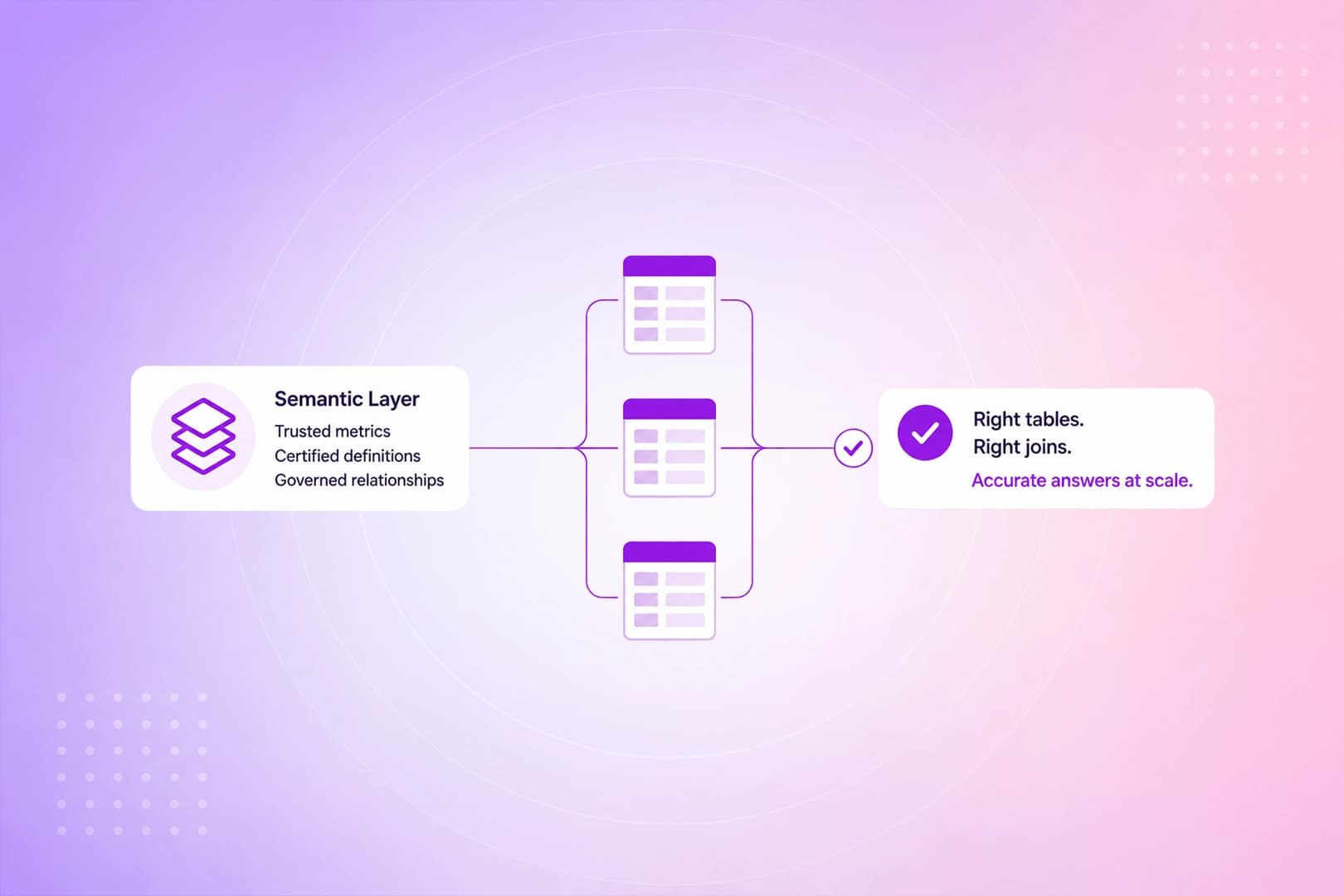
Somewhere between the proof of concept and the production warehouse, text-to-SQL systems hit a wall, and teams that have lived through it describe the same experience: the tool that answered flawlessly against a curated 15-table demo begins missing badly once it faces the real estate of several hundred tables. The decline is not gradual or graceful. Practitioners consistently report it arriving as a collapse, and the threshold where it becomes undeniable tends to sit surprisingly low, often at a scale of tens of tables rather than thousands. Understanding why the collapse happens at that scale explains what actually fixes it, and why the fix is architectural rather than a matter of waiting for smarter models.
The collapse is combinatorial, not linear
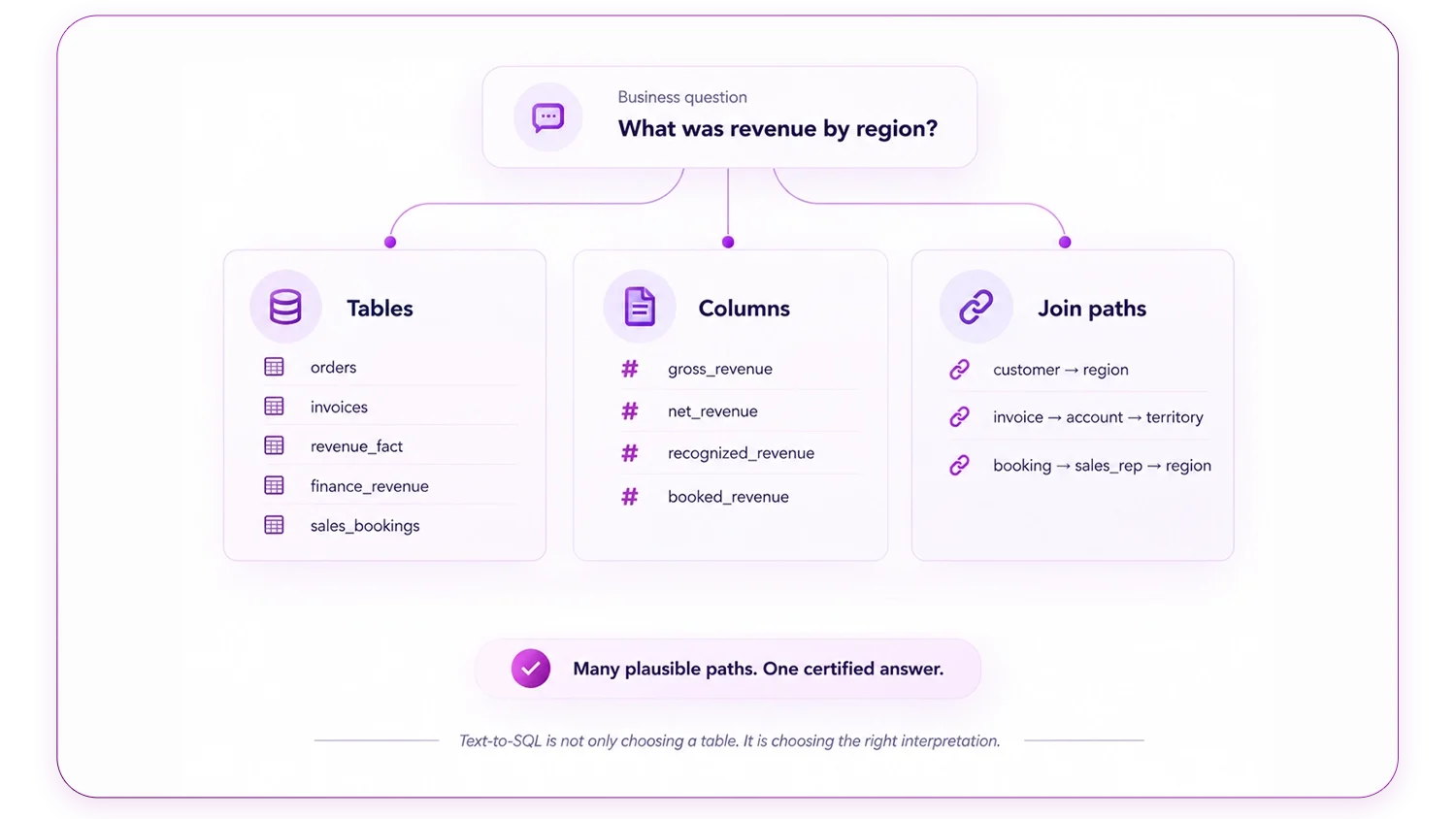
The intuition that a warehouse with ten times the tables is ten times as hard is wrong, and the reason is that query generation is a search problem. To answer a question, the system must select the right tables, the right columns within them, and the right join paths between them. Each of those choices multiplies against the others. With a dozen tables, the space of plausible interpretations of a question is small, and the correct one is usually the obvious one. With a hundred tables, a single business question can map to dozens of superficially reasonable table combinations, joined along multiple superficially reasonable paths, and only one combination reflects how the business actually computes the metric. The search space grows combinatorially while the model’s basis for choosing, names and schema structure, stays as thin as it ever was.
Real warehouses actively mislead the search
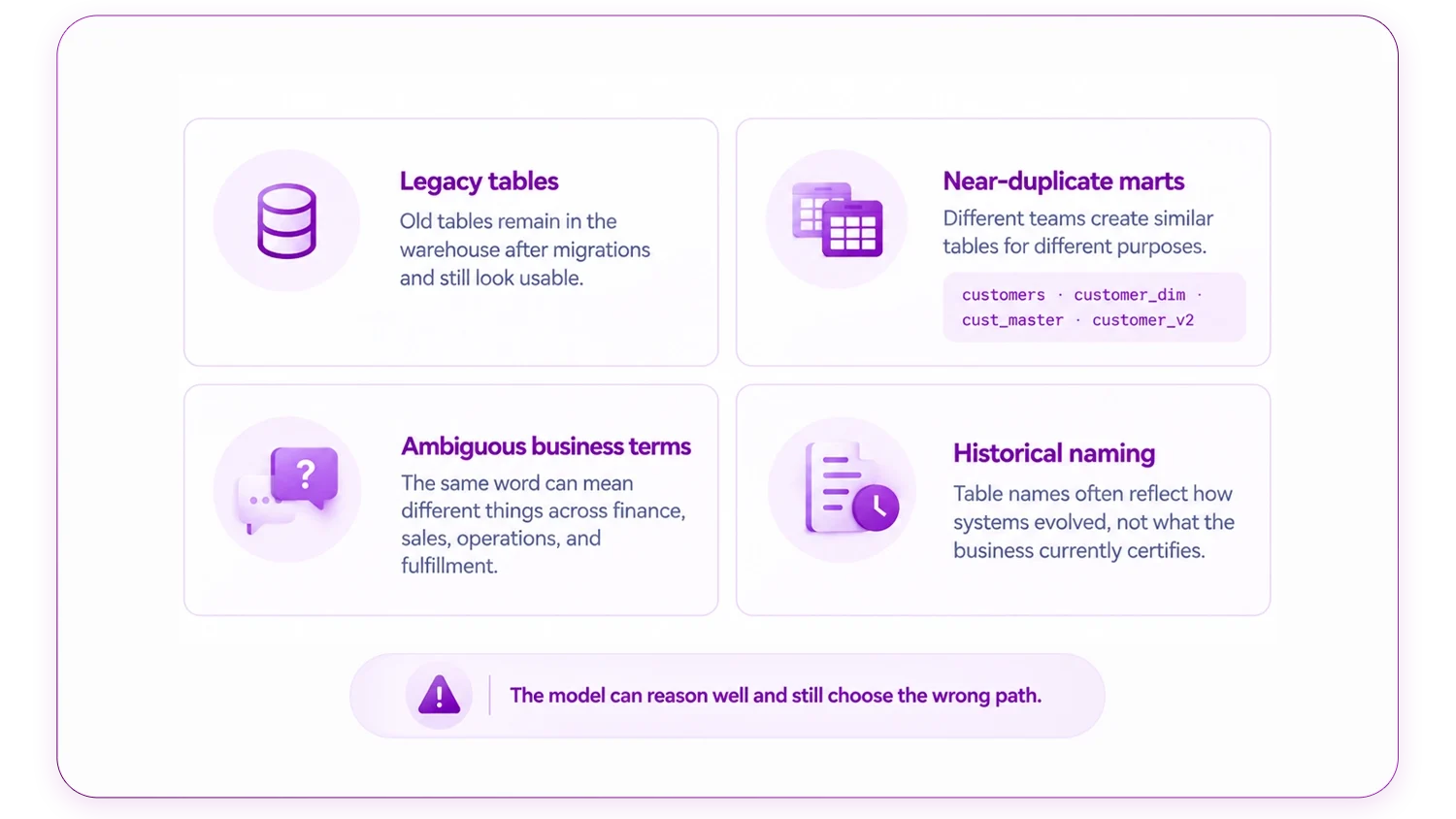
Scale alone would be manageable if enterprise schemas were honest, but they are not, through no fault of anyone. Warehouses accumulate. Migrations leave behind superseded tables that still hold data. Teams build near-duplicate marts of the same entities for their own purposes, so customers exists alongside customer_dim, cust_master, and a v2 of one of them, and only institutional memory knows which is certified. Naming stops encoding meaning and starts encoding history. Semantic ambiguity compounds it: orders in the fulfilment schema and orders in the finance schema are different grains of different truths. To a model reasoning from the schema, every one of these artefacts is a live, plausible candidate. The model is not failing to reason. It is reasoning correctly over a landscape where most of the well-marked paths lead somewhere wrong.
Context limits make it worse, and context alone cannot fix it
There is also a mechanical constraint. A schema of hundreds of tables with their columns, types, and relationships is a large object, and systems must choose what portion of it to show the model for a given question. Retrieve too narrowly and the correct table may never be in view; retrieve broadly and the model wades through hundreds of distractors, where the misleading candidates above sit alongside the right ones with equal prominence. Long-context models relax the mechanical limit but not the underlying problem, because the problem was never fitting the schema into the window. It was that the schema does not contain the information that distinguishes the certified path from the plausible one. Showing the model more of an ambiguous map does not make the map less ambiguous.
What the semantic layer changes: from search to lookup
The semantic layer fixes the collapse by removing the search. Instead of asking the model to rediscover, per query, which of four customer tables is real and how revenue joins to region, the semantic layer holds those resolutions as certified facts: this metric is computed from these columns in these tables along these join paths, as approved by the business. The model’s job contracts from navigating the full combinatorial space to composing an answer from pre-resolved, governed components. The distractor tables never enter the candidate set, because candidacy is now defined by certification rather than by name similarity. This is why the approach scales where schema-prompting does not: the ambiguity that grows combinatorially with warehouse size is exactly the part the semantic layer eliminates, so warehouse growth stops degrading answer quality.
The traditional objection is maintenance: manually authored semantic models are themselves a large project, and they drift as the warehouse evolves, which is how metric definitions rot. This is the specific problem QuaerisAI’s Smart Semantic Layer is built to address. The layer learns from interaction: when an analyst corrects a resolution or refines how a question maps to data, the correction persists as part of the layer, so coverage compounds with use instead of decaying with time. The maintenance burden that made semantic layers a tax becomes the byproduct of people simply using the system.
What this means for evaluation
The practical lesson for buyers is that a text-to-SQL evaluation conducted on a small clean schema measures nothing about production behaviour. The demo scale sits below the collapse threshold by design. A meaningful evaluation runs on your own warehouse at its real size, includes questions whose correct answers route through your ambiguous regions, near-duplicate tables, legacy artefacts, and multi-hop joins, and checks whether the platform resolves them through governed definitions or through guesswork. Systems that pass at that scale do so because their architecture removed the combinatorial problem. Based on QuaerisAI customer deployments and published materials, that is the architecture standing behind adoption rates of 30 to 60 percent: sustained enterprise adoption is only possible when accuracy survives contact with the full warehouse.
Frequently asked questions
Is 50 tables a hard threshold?
No. It is a useful shorthand for the scale at which practitioners commonly report the failure becoming obvious, but the true driver is ambiguity rather than the table count itself. A pristine 80-table schema with unambiguous naming may behave well; a 40-table schema with three overlapping customer marts and legacy artefacts may already be inside the collapse. Table count correlates with ambiguity in real warehouses, which is why the shorthand holds in practice.
Do retrieval techniques over the schema solve this without a semantic layer?
They mitigate the mechanical part, choosing which schema fragments to show the model, and are worth having. They do not solve the core problem, because retrieval selects candidates by relevance signals like name similarity, and in a real warehouse the misleading candidates are relevant by exactly those signals. Distinguishing the certified table from its plausible twins requires governed knowledge, which is what a semantic layer is.
How much semantic modeling is needed before the system is usable?
Far less than full-warehouse coverage. Question traffic in most organisations concentrates heavily on a modest set of core metrics and entities, so certifying the definitions behind that core covers the bulk of real usage. With an auto-learning layer like QuaerisAI’s, coverage then extends organically along the paths people actually query, rather than requiring the whole estate to be modeled up front.