
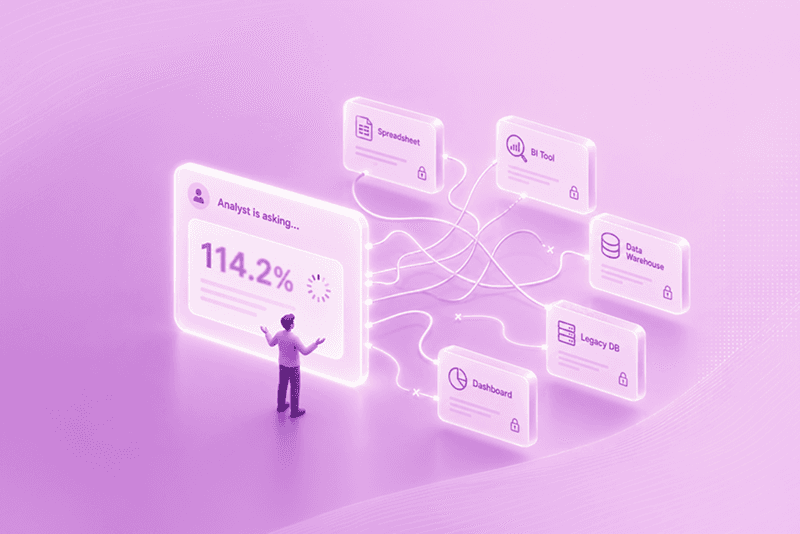
A majority of analytics teams are not underperforming. They are working at full capacity inside a system that was never designed to scale with the volume of questions a modern business generates. The problem is not the people. It is the architecture built around them, and understanding that distinction is the first step to fixing it.
The Repeatable Pattern
When analytics teams fall behind, the instinctive responses tend to follow a familiar sequence. Leaders call for more dashboards. Procurement teams evaluate new tools. Hiring managers post for more analysts. None of these address the actual problem.
Most organisations already have more data than they can use, more dashboards than any team trusts, and more incoming requests than a reasonably sized analytics function can clear. And yet, despite all of that investment, the same failure mode keeps appearing: a question gets asked, and the answer does not arrive fast enough for the decision it was meant to inform. That lag, multiplied across every team and every decision cycle, is where the real cost lives.
What Analysts Actually Do All Day
There is a large gap between what analytics teams are hired to do and what they actually spend their time on. The honest version of the job description at most organisations looks something like this: answering the same question from a different stakeholder for the twelfth time, rebuilding the same business logic in a slightly different format, chasing down metric definitions that should have been standardised long ago, sitting in meetings explaining numbers that the audience does not fully trust, and working through a request backlog that adds items faster than it clears them.
This is not insight generation. It is ticket management with a SQL layer on top. The analysts doing this work are not slow or untalented. They are allocated to work that should not exist in the form it currently does, and the best ones feel it most acutely because they can see clearly what they would rather be doing.
Where the Bottleneck Actually Is
When decisions take too long, the analytics team is usually the first place leadership looks. This is the wrong diagnosis. The bottleneck is not the analyst. It is the system that requires every business question to travel through a human intermediary before it can be answered.
The standard path is predictable: a business user has a question, they submit a request, it joins a queue, it eventually gets prioritised, an analyst works on it, and the answer arrives days later, sometimes after the window to act on it has already closed. The system routes every question through a person regardless of whether that question actually requires one. When you build a structure where thinking does not scale, the problem is not the thinkers.
Why AI Creates Anxiety on Analytics Teams
When AI tools arrive with the promise of instant answers, the reaction from analytics professionals is often scepticism or outright resistance. This is a rational response. The framing of AI as something that can answer questions automatically sounds, from the analyst’s perspective, like a straightforward argument that the analyst’s role is redundant.
The more accurate framing is different. If AI takes over any portion of the analytics function, the work it displaces is the work that analytics teams find least valuable and most draining: the repeat questions, the low-complexity extractions, the formatting requests, the work that should never have required a credentialled analyst in the first place. The genuine risk for analytics professionals is not AI replacing them. It is staying inside a system that continues to allocate their time to work that a machine could handle, while the higher-value work they are capable of never gets done.
The Shift Most Organisations Have Not Made
The more useful frame for AI in analytics is this: it does not replace analysts, but it does expose how much of what currently occupies an analyst’s day should never have been their job. When the repeat questions are handled automatically, when definitions are standardised and no longer require manual interpretation, when routine extractions no longer require a ticket, what is left is the work that actually requires human judgment, contextual knowledge, and strategic thinking.
The practical outcomes of this shift are measurable. Request backlogs shrink. Metric definitions stabilise because they are enforced consistently rather than reinterpreted per request. Business users get faster access to answers they can trust. And analysts, freed from the low-value queue, can focus on the analysis that actually influences decisions rather than reporting on decisions that have already been made.
The Two Options Available
When an analytics team is consistently overwhelmed, there are two available responses. The first is to add headcount and continue operating the same system, which distributes the load without addressing the structural cause. The second is to fix the system so that the team’s capacity is allocated to work that requires their expertise.
Most organisations choose the first option because it feels more immediate and more controllable. It also explains why the problem tends to persist regardless of how many analysts are added. The queue expands to meet the available capacity, and the cycle continues.
What Actually Changes
When the structural problem is addressed and analysts are no longer the required intermediary for every data question, the nature of their contribution shifts in a meaningful way. They become the owners of data definitions and business context rather than the executors of routine requests. They move from explaining last quarter’s numbers in meetings to helping shape how next quarter’s decisions get made. Their value does not decrease. It becomes more visible because it is being applied to work where it is genuinely differentiated.
This is also why most AI implementations in analytics fail to deliver on their stated promise. They focus on replacing outputs, generating automated reports and pre-built dashboards, without addressing the underlying system that created the bottleneck. Automating the wrong workflow at higher speed does not fix the problem. It accelerates it.
What the Goal Actually Was
The dashboards were never the goal. The analysts were never the goal. The goal was always faster, more reliable decisions made by the people responsible for them. If the current system cannot consistently deliver that, the answer is not to add more of the same components. It is to change what the system asks of the people inside it.
Fixing the structure around an analytics team is harder and slower than adding headcount. It is also the only approach that actually resolves the problem rather than deferring it.