
Enterprise agentic AI moved from pilot budgets to production commitments faster than most other categories of enterprise software. That speed created a side effect worth naming upfront: one industry guide to this exact topic calls out “agent washing,” vendors relabeling existing chatbots, RPA scripts, or linear workflow tools as agents without the underlying system actually doing autonomous, multi-step reasoning. The same guide argues genuine agentic AI requires autonomous decision-making, multi-step reasoning, and dynamic error handling, and that most products marketed this way do not clear that bar.
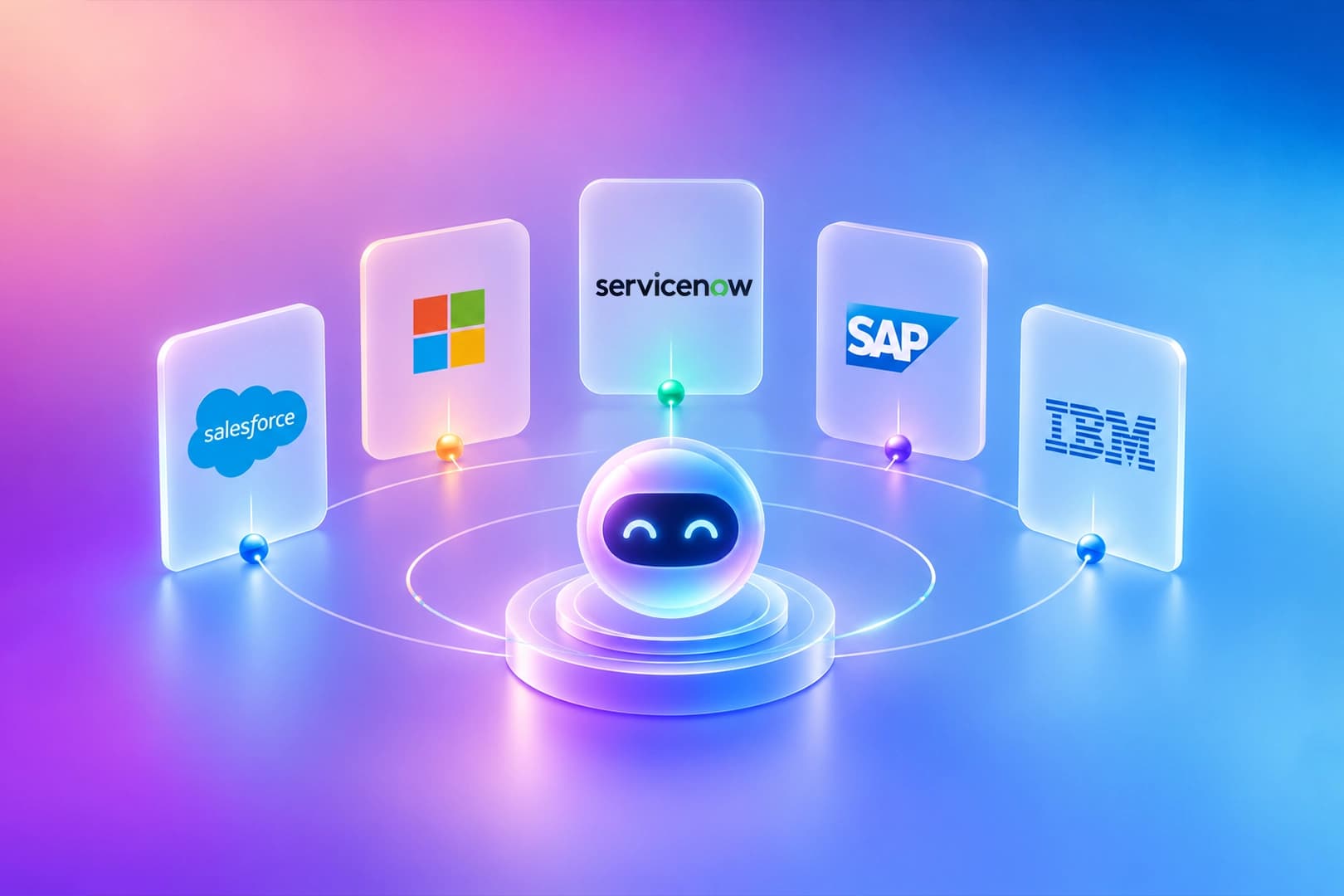
With that caveat in mind, five platforms show up consistently across independent comparison sources (not just their own marketing) as the ones enterprise teams are actually deploying in production. This list is organized by the enterprise system each one is built around, since that is the factor most buyer’s guides agree should drive the decision.
1. Salesforce Agentforce
Agentforce is Salesforce’s agent platform, built to operate directly on Salesforce’s own data model so agents work against current CRM records without a separate synchronization layer. Governance runs through Salesforce’s Einstein Trust Layer and existing audit logs, and MuleSoft extends its reach into other systems. As of independent 2026 coverage, Salesforce has closed roughly 29,000 Agentforce deals since launch, generating around $800 million in annual recurring revenue, figures reported externally rather than only claimed by Salesforce itself.
Best for: organizations already running Salesforce as their primary CRM who want agents acting on live customer data without a new integration layer.
2. Microsoft Copilot Studio
Copilot Studio is Microsoft’s low-code agent builder, with independent 2026 reporting citing roughly 160,000 organizations running more than 400,000 custom agents on the platform. Its core strength is depth of integration across the Microsoft ecosystem, Microsoft 365, Dynamics, and Azure, making it the practical default for organizations already standardized on Microsoft’s stack. Comparison guides consistently note it alongside Agentforce as one of the two platforms with the fastest time to production for pre-built use cases, typically four to six weeks.
Best for: Microsoft-centric organizations that want agent building accessible to business users, not only engineering teams.
3. ServiceNow AI Agents
ServiceNow’s agent capabilities sit inside its existing IT service management, HR, and customer service management workflows, under the Now Assist feature set. In April 2026, ServiceNow restructured its commercial model to embed an AI Control Tower and Workflow Data Fabric across every pricing tier by default rather than as an add-on, a move independent coverage described as a signal that governance-first architecture is becoming a baseline market expectation, not a premium feature. ServiceNow also acquired Moveworks in late 2025, which now operates under the ServiceNow umbrella and extends its employee-facing agent capabilities across Slack and Microsoft Teams with more than 100 pre-built integrations.
Best for: large enterprises already running ServiceNow for IT service management that want to extend agent-driven support into HR and broader employee operations.
4. SAP Joule Studio
SAP’s agent platform evolved substantially through 2026. Joule Studio, a full agent builder on SAP’s Business Technology Platform, reached general availability in Q1 2026, and Joule Studio 2.0 followed at SAP Sapphire in May 2026 with a fully managed, zero-infrastructure version aimed at citizen developers rather than only professional coders, backed by a 100 million euro partner fund. SAP describes agents built this way as natively grounded in a business’s existing SAP data, processes, and semantics rather than connected to them afterward. Reported agent and skill counts vary by source and by which specific SAP AI product is being described, ranging from roughly 40 specialized agents and 2,400 skills in one 2026 analysis to 200 domain-specific agents announced with Joule Studio 2.0, so treat any single number as a snapshot rather than a fixed figure, and confirm current scope directly with SAP.
Best for: enterprises running SAP as their core ERP that want agents grounded in existing SAP business processes without a separate integration project.
5. IBM watsonx Orchestrate
watsonx Orchestrate positions itself as a governance-first control plane rather than a single-vendor agent builder, with a stated skills catalog of more than 150 pre-built automations and integrations spanning SAP, Salesforce, and ServiceNow. Independent buyer’s guides consistently rate its governance and auditability as the strongest in this category, describing it as built for large, regulated enterprises where explainability is not optional, with the tradeoff that deployment cycles tend to run longer than SaaS-native competitors due to procurement rigor. IBM also released an Agent Management Platform in March 2026, a vendor-agnostic governance layer that can manage agents across other frameworks and vendors, including LangGraph, CrewAI, Google’s Agent Development Kit, AWS AgentCore, Microsoft Foundry, and Salesforce Agentforce, from a single control plane.
Best for: regulated enterprises running multiple AI agent vendors or frameworks that need one governance layer over all of them, not just IBM’s own agents.
The pattern worth noticing
Every platform on this list leads with governance and grounding in existing business systems, not raw agent capability alone. That is not a coincidence. Gartner’s own 2026 Analytics and BI Magic Quadrant made a related point for the adjacent BI category: success increasingly depends on more than a large language model, it requires governed business context and the ability to operationalize decisions inside existing workflows. The same logic applies here. An agent that reasons well but cannot prove what it touched, why, and under whose permission is a harder sell in an enterprise than a system that is somewhat less flashy but fully auditable.