
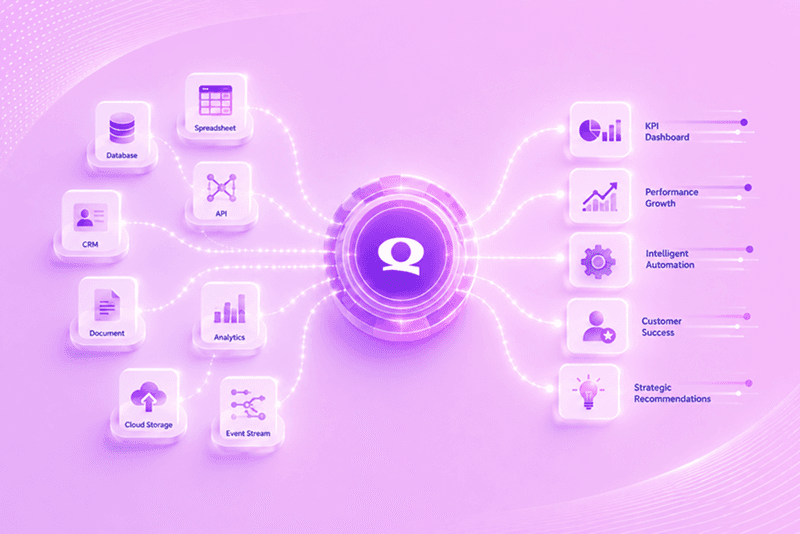
Every organisation collecting data is making an implicit bet: that the data will eventually influence a decision. The size of the data warehouse, the sophistication of the pipeline, the number of dashboards maintained, none of it has inherent value. The value only materialises at the moment a decision is made better because of it. Everything before that moment is cost. The decision is the return.
This framing matters because most organisations measure the wrong things. They track data volume, dashboard usage, and query counts. They rarely track how often a business decision was made faster, or more accurately, because of the data available to the person making it. The gap between those two measurement approaches explains why organisations can have world-class data infrastructure and still feel like they are flying blind.
The Distance Between Data and Decision
In most enterprises, data and decisions do not live in the same place. Data lives in warehouses, pipelines, and dashboards maintained by a technical team. Decisions live in meetings, calls, and planning cycles run by business leaders. The distance between the two is bridged by a process: someone with a question requests an answer from someone with data access, waits for it, receives it, and then decides whether to trust it enough to act on it.
Every step in that process introduces delay. And delay has a specific cost in decision-making contexts: the window to act narrows, the situation changes, and the answer that arrives is answering a slightly different question than the one that was asked. By the time a finance leader has a verified variance analysis, the budget cycle that needed it may have already closed. By the time a sales director has pipeline coverage data, the quarter it was meant to inform is already in its final week.
The data existed. The decision was still made without it, or made on older data that was less accurate. The value that could have been realised was not, because the timing was wrong.
Why Timing Is the Underrated Variable
Most conversations about data quality focus on accuracy. Most conversations about data access focus on permissions and tooling. Relatively few focus on timing, even though timing is frequently the variable that determines whether data influences a decision at all.
A perfectly accurate answer that arrives two days after the decision was made has a value of zero to that decision. An answer that is 95% accurate and arrives before the meeting starts has real value. This is not an argument for trading accuracy for speed. It is an argument that the delivery architecture matters as much as the data itself, and that most organisations have invested heavily in the former without solving the latter.
The organisations where data consistently influences decisions are not necessarily the ones with the most data or the most sophisticated models. They are the ones where the person making the decision can get a trustworthy answer before the decision point, not after it.
What Breaks the Connection Between Data and Decision
Three structural problems account for most of the gap between data availability and decision quality in large organisations.
The first is access friction. Getting an answer requires knowing which dashboard contains the relevant metric, understanding how to interpret it, and trusting that the definition it uses matches what the business actually means by that term. For non-technical decision makers, these requirements are often too high. They either rely on an analyst intermediary, which introduces delay, or they make the decision without the data, which introduces risk.
The second is definition inconsistency. When the same question asked by two different teams returns two different numbers, the result is not just confusion. It is a systematic erosion of trust in data as a decision-making input. Once a finance director has been burned by a discrepancy between what the CRM reports and what the ERP reports, they begin treating data as a starting point for a debate rather than a basis for a decision.
The third is reactive intelligence. Most analytics infrastructure is built to answer questions after they are asked. It is not built to surface the information a decision maker needs before they know they need it. A sales leader should not have to remember to check pipeline coverage every Friday morning. The system should alert them when coverage drops below the threshold that matters, at the moment it happens.
What Changes When Data Reaches the Decision
When these structural problems are addressed, the nature of the relationship between data and decisions changes in a concrete way. Decision makers stop treating data as something that requires effort to reach and start treating it as something that is already present when they need it. The question “do we have data on this?” is replaced by “what does the data say?” That shift, while it sounds simple, represents a fundamentally different operating model.
The decisions that benefit most from this shift are not the large strategic ones that get weeks of analysis time. Those decisions already get the data they need. The decisions that change are the daily and weekly ones: which accounts to prioritise, whether a budget variance warrants immediate action, which operational metrics are drifting outside acceptable ranges. These decisions are made constantly, they are made quickly, and they are made with whatever information is immediately to hand. When that information is accurate and governed, the cumulative effect on business outcomes is significant.
The Governance Requirement
Speed without trust does not solve the problem. If a business leader receives a fast answer but cannot verify where it came from, whether the metric definition matches the one used in last quarter’s board presentation, or whether they were supposed to have access to that data at all, the answer will not influence the decision. It will trigger a verification process that reintroduces the same delay the speed was meant to eliminate.
This is the fundamental weakness of general-purpose AI tools applied to business data questions. They can generate answers quickly. They cannot guarantee that those answers are grounded in the organisation’s actual definitions, drawn from authorised data sources, and scoped to the querying user’s role. For a finance leader making a budget decision, or a compliance officer reviewing a control exception, that guarantee is not optional. It is the difference between an answer they can act on and an answer they have to verify before they can act on it.
Governed analytics addresses this by ensuring every answer carries its source, its metric version, and its access record. The decision maker does not need to trust the system blindly. They can verify the answer the same way they would verify any other business number, which means they actually use it.
The Measure That Actually Matters
If an organisation wants to understand whether its data investment is delivering returns, the most useful question is not how much data it has, how many dashboards it maintains, or how many queries it processes per month. The most useful question is: how often does a decision maker have the information they need, at the moment they need it, in a form they trust enough to act on?
Every other metric is a proxy for that one. And every investment in data infrastructure that does not ultimately improve that number is investment that has not yet reached the point where value is created.
Data value is not realised when data is collected. It is not realised when data is stored, processed, or visualised. It is realised at the moment a decision becomes better because of it. Building the infrastructure that connects those two things is the actual problem worth solving.