
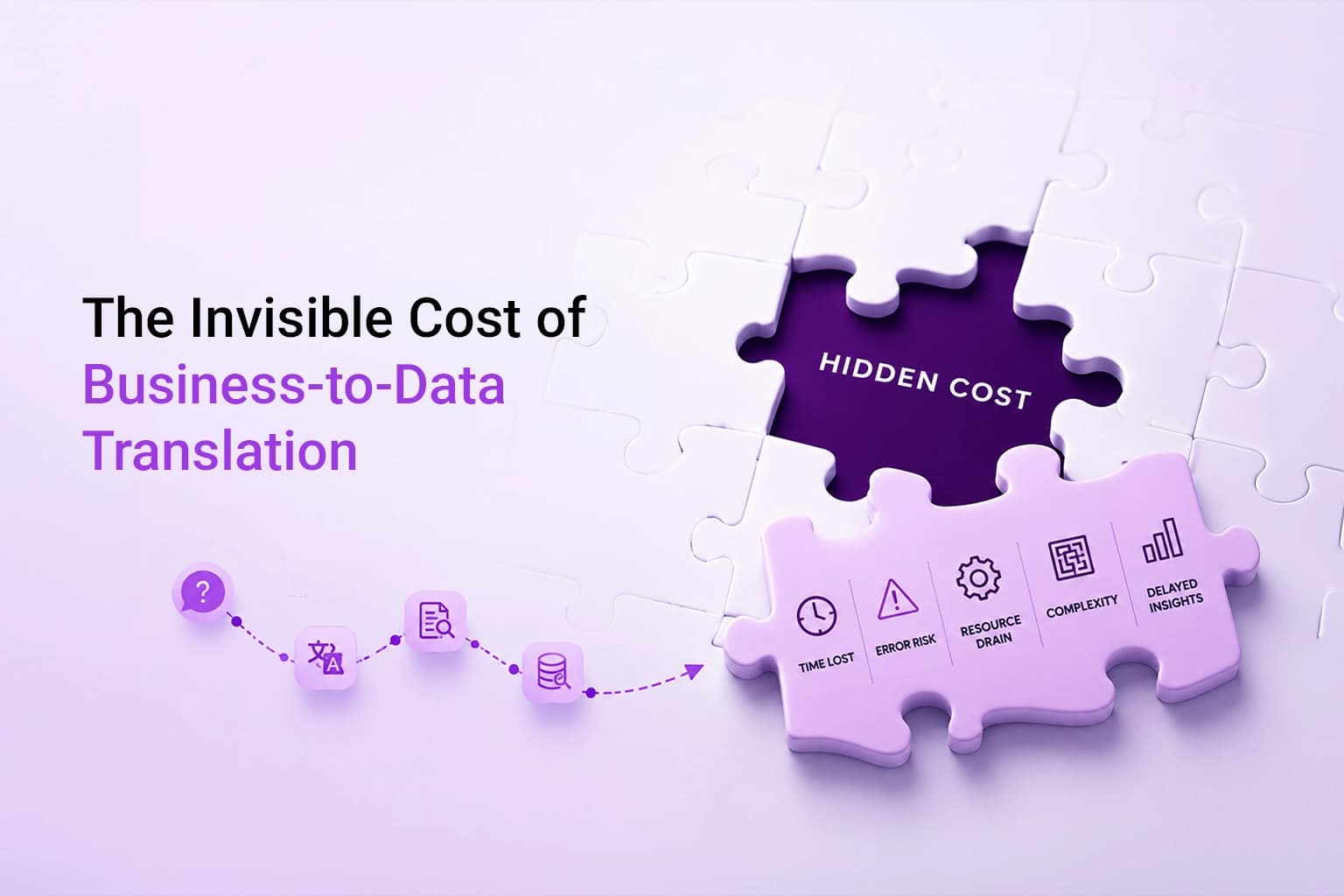
There is a step inside every enterprise data workflow that nobody budgets for, nobody measures, and almost nobody talks about. It sits between the moment a business user asks a question and the moment an answer arrives. It involves a human intermediary, a rewrite, a queue, and a delay that compounds quietly across every question the organisation ever asks. It is called translation, and it is one of the largest sources of friction in modern data operations.
The Translation Layer No One Talks About
When a business user asks a question in everyday language, it does not travel directly to an answer. It enters a workflow. The question gets rewritten by someone who understands both the business intent and the data structure. An analyst interprets what was actually being asked. A query is built against the relevant dataset. Results are pulled, validated, and then returned, often days after the original question was raised.
This process has become so embedded in how enterprise data teams operate that it feels normal. It is not. It is a system built around translation rather than speed, and every translation step introduces delay that compounds across every question the organisation ever asks.
Delay Is Not Just Time. It Is Cost.
Analytics teams typically track dashboard usage, report delivery rates, and model performance. Few track the one metric that most directly connects data investment to business outcomes: time to answer. That gap matters enormously in practice.
Each translated question creates a ticket, which joins a queue, which creates a dependency on a specific analyst, which delays the decision the question was meant to inform. Individually, each instance feels manageable. Accumulated across an organisation over a quarter, it builds a decision backlog that no one has explicitly created and very few can clearly see. The organisation slows down without identifying when or why it started to.
Backlog Is the Symptom. Missed Windows Are the Outcome.
When answers take days instead of minutes, teams adapt in ways that look like efficiency but are actually risk. They stop asking questions that require a data request. They rely on instinct for decisions that should be data-informed. They reuse old reports rather than pulling current figures. They move forward without clarity because waiting for clarity costs more time than they have.
The downstream cost of this adaptation is not abstract. Pricing windows close before the margin analysis arrives. Market shifts go undetected until they appear in end-of-quarter results. Operational issues surface late because no one had asked the question that would have caught them early. By the time the answer arrives, the moment it was meant to serve has passed.
The Analyst Bottleneck Was Never the Goal
Analysts are not the problem here. They are doing exactly what the system requires of them. The system is the problem. It routes every business question through a translation step that requires a human intermediary, forcing analysts into a loop of interpreting business language, converting it into queries, and delivering the same categories of answer repeatedly to different stakeholders.
This is low-leverage work for people hired to do high-leverage thinking. It creates dependency rather than capability. It limits the scale of what a data team can support. And it buries expertise under volume, so the most capable analysts spend the most time on the most routine requests because those requests never stop arriving.
Translation Breaks Trust as Well as Speed
Speed is one dimension of the problem. Trust is another, and in regulated or high-stakes environments it is often the more damaging one. Every time a question is translated, there is a risk that what the business meant is not precisely what the query captures. The business user receives an answer and is not entirely certain it reflects what they asked. They request a follow-up. They validate the output manually. They ask for a revised version.
Each of these steps extends the cycle further. Speed drops. Confidence drops alongside it. And when confidence in the answer drops, the decision it was supposed to support stalls. Speed without trust creates risk rather than removing it. The compounding cost of repeated translation is not just slower decisions. It is decisions made with less confidence, which is a different and more persistent problem.
The Workflow Becomes the Problem
At scale, the pattern is consistent across organisations. Questions require tickets. Tickets require translation. Translation creates delay. Delay creates hesitation. Hesitation creates risk. This is not a data problem and it is not an analyst capacity problem. It is a workflow problem, and it cannot be fixed by adding more dashboards or more headcount, because neither of those changes removes the translation step that sits between question and answer.
What Removing Translation Actually Changes
When business users can ask questions in their own words and receive governed, explainable answers directly, the workflow resets at every level of the organisation. For business leaders, questions get answered inside the window when action is still possible, and decisions that previously required a data request become immediate. For analysts, the volume of repeat requests drops, and the time recovered goes toward the complex, judgment-intensive work that actually requires their expertise. For the organisation overall, decision backlog shrinks, workflow simplifies, and the time between question and action compresses to a degree that changes how teams behave rather than just how fast a single query runs.
Where Quaeris Fits
Quaeris removes the need to translate business questions into queries. Teams ask questions in their own words and receive trusted, explainable answers grounded in governed data, without a ticket, without a rewrite, and without a queue. Every answer carries its source and lineage so the business user can see exactly where the number came from and why the system produced that specific result.
This is not a faster dashboard. It is a different point of intervention: a decision acceleration layer that connects data, documents, and context and closes the gap between question and action at the moment the question is asked, not days afterward.
The Real Metric
The hidden cost of translating business questions is not technical debt. It is temporal debt. Every translated question adds time. Every added hour increases the risk that the decision it was meant to inform arrives too late to matter. Every delay reduces the window in which action is still possible.
Organisations that remove translation do not just move faster. They ask more questions, trust more answers, and act before the moment passes. That is the compounding advantage that closing the gap between question and action actually produces.