
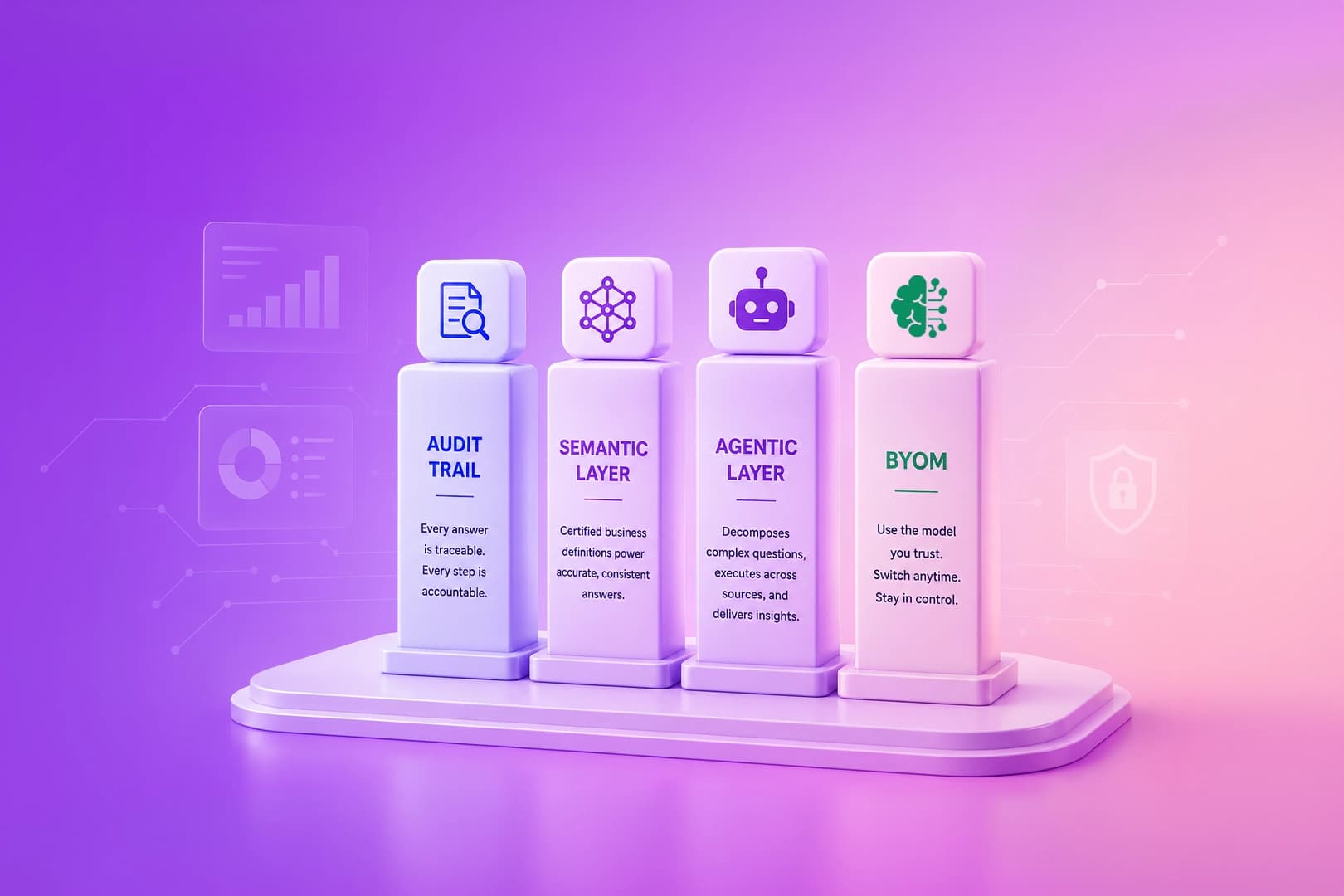
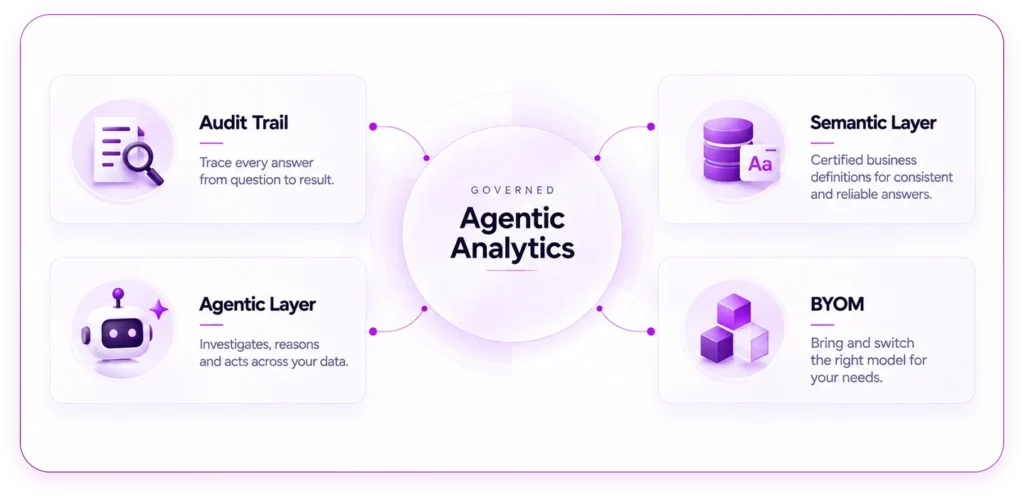
Four capabilities separate a governed agentic platform from a chatbot bolted onto a warehouse. Remove any one of them and the structure fails in a specific, predictable way. This piece defines each pillar, explains what breaks without it, and shows how the four reinforce one another when they are built as one system rather than assembled from separate tools.
Pillar one: the audit trail
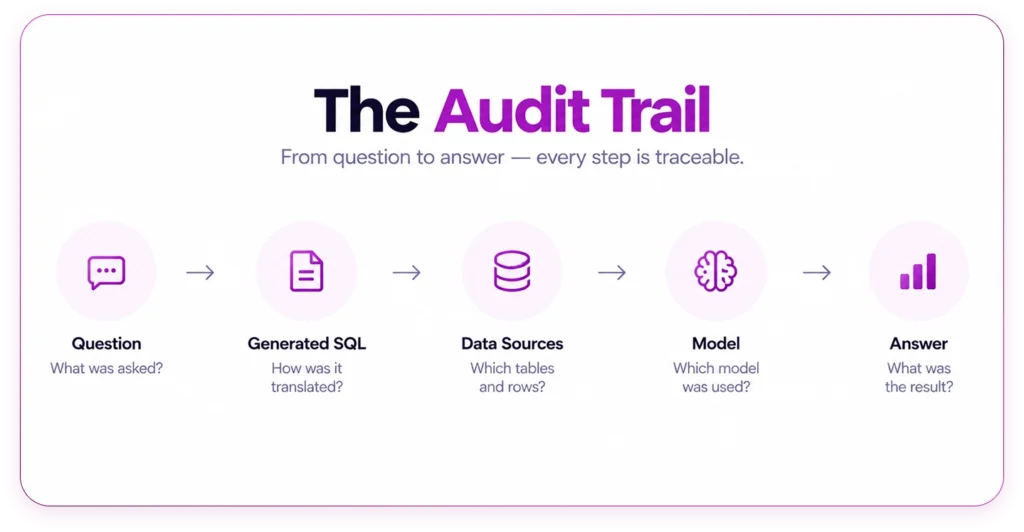
Every question asked of an agent should produce two artefacts: the answer, and the record of how the answer was produced. The audit pillar means logging the full chain on every interaction: who asked, what they asked, which SQL the agent generated, which tables and rows it touched, which model produced the reasoning, and what came back. This is the prompt-level audit trail, and it is the difference between an answer you can act on and an answer you can defend.
Without it, every agent response is an orphan. When a number in a board deck is challenged three months later, there is no way to reconstruct where it came from. Internal audit cannot test the system. Regulators in banking, insurance, and healthcare cannot accept its outputs as evidence. The absence of an audit trail does not make an agent less useful day to day. It makes the agent indefensible on exactly the day it matters most.
Pillar two: the semantic layer
An agent is only as accurate as its understanding of what the business means by its own words. The semantic pillar supplies that understanding: certified definitions of metrics, dimensions, and business terms that the agent consults before it writes a line of SQL. When someone asks about net revenue, the agent does not guess which of the fourteen revenue-adjacent columns in the warehouse to use. It uses the one the business certified.
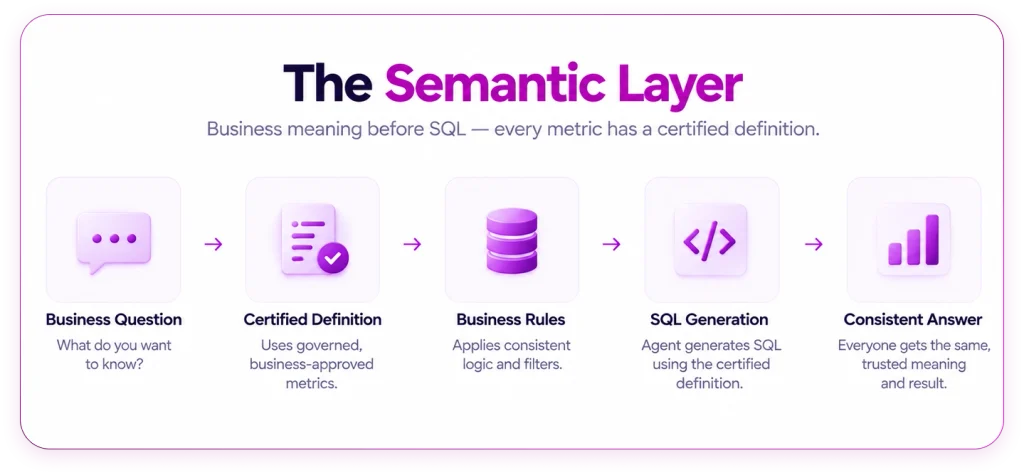
QuaerisAI’s Smart Semantic Layer adds a property that distinguishes it from manually authored alternatives: it learns. When an analyst corrects a definition or refines a query, the correction feeds back into the layer, so the next person asking a similar question benefits from it. Without a semantic layer of some kind, an agent hallucinates business logic, and it does so fluently, which is worse than failing loudly. Confidently wrong answers are the fastest way to destroy trust in an analytics deployment.
Pillar three: the agentic layer
The agentic pillar is what makes the platform more than search. Real analytical questions are rarely answered by one query. Why did margin dip in the northeast last quarter is a plan: pull the margin trend, decompose it by product line, check input costs, compare against the same period last year, and assemble a finding. The agentic layer is the capability to decompose a question into steps, execute them across structured and unstructured sources, and synthesise a result, autonomously.
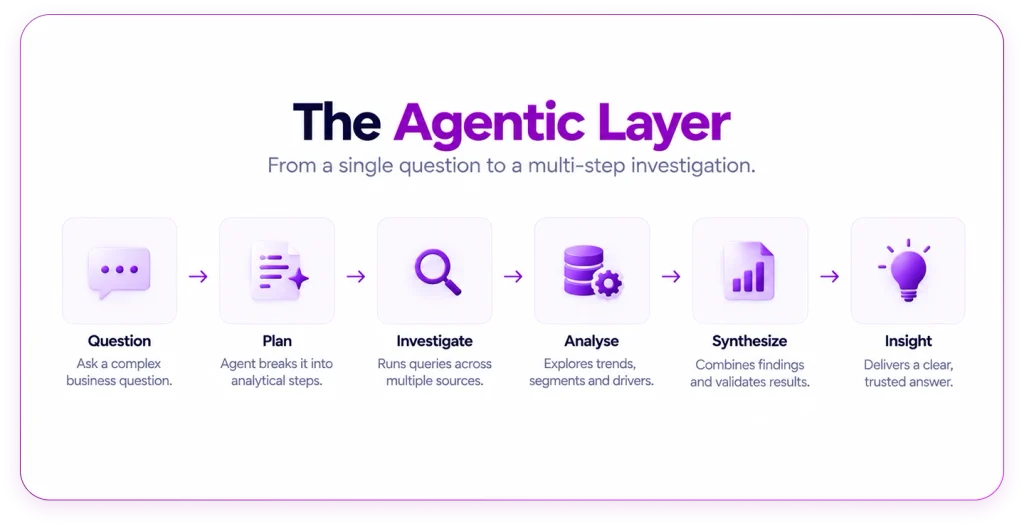
Without it, the platform is a text-to-SQL translator: useful for single-shot lookups, incapable of investigation. The user gets a number when they needed an explanation. The distinction matters commercially because the investigation work is where the senior-staff hours actually go. Based on QuaerisAI customer deployments and published materials, agentic deployment in audit engagements has reduced standard engagement time from 170 hours to 70 hours, a 59 percent reduction, precisely because the multi-step work is where the time was.
Pillar four: BYOM
Bring your own model means the platform runs on the language model the enterprise chooses, whether from Anthropic, OpenAI, Google, or Meta, rather than binding the customer to a single vendor’s model. This pillar looks like a procurement detail until the first time it is tested. A compliance team mandates a specific model for data-residency reasons. A model vendor changes pricing. A new model release outperforms the incumbent on SQL generation. In a BYOM architecture, each of these is a configuration decision. In a locked architecture, each is a re-platforming project.
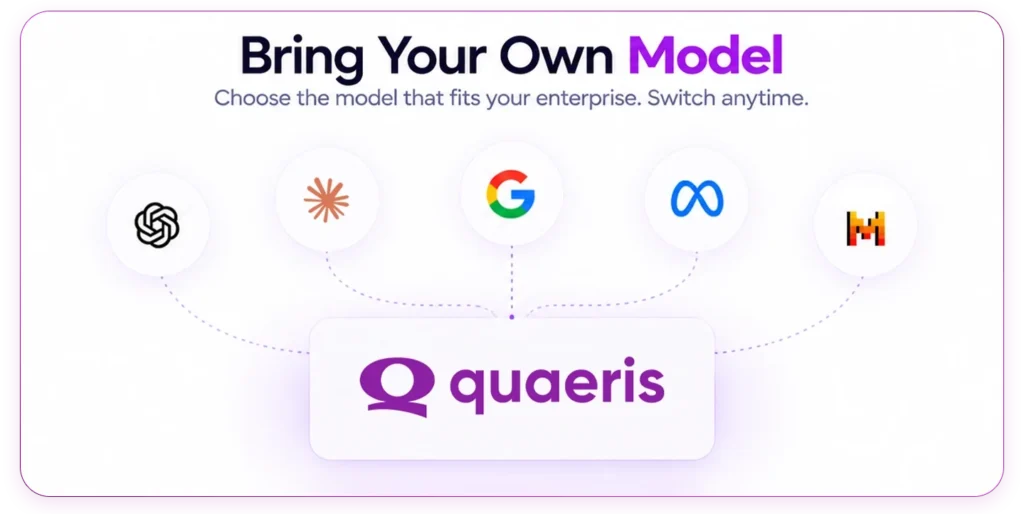
BYOM also changes the negotiating position. An enterprise that can switch models holds pricing power an enterprise that cannot switch has surrendered. And for regulated buyers, model choice is increasingly a compliance requirement in its own right, because model provenance is becoming part of what auditors and regulators expect organisations to document.
Why the pillars only work together
The four pillars are not a feature list. They are load-bearing in combination. The audit trail is only meaningful if the semantic layer makes answers deterministic enough to be worth auditing. The semantic layer only pays for itself when an agentic layer is asking it thousands of questions a day. The agentic layer is only deployable in the enterprise because the audit trail makes its autonomy accountable. And BYOM keeps the whole structure durable as the model market shifts underneath it.
This is why assembling the equivalent from point solutions rarely works. A logging tool, a metrics store, an agent framework, and a model gateway from four vendors produce four integration seams, and governance fails at seams. Governed Agentic Analytics is one architecture, and the four pillars are its definition.
Frequently asked questions
Which pillar should an evaluation test first?
The audit trail, because it is the hardest to retrofit and the easiest to verify in a demo. Ask the vendor to show the complete record for a single query: the prompt, the generated SQL, the tables touched, the model used, and the result. If that record does not exist or requires engineering effort to produce, the other three pillars are standing on sand.
Is a semantic layer still necessary if the model is very capable?
Yes. Model capability improves general reasoning, but no model can know that your finance team excludes intercompany transfers from net revenue, or that fiscal Q1 starts in February. Those are facts about your business, not facts about the world, and they have to be supplied by a governed definition layer. Stronger models make the semantic layer more valuable, not less, because they execute certified definitions more reliably.
Does BYOM mean the customer manages model infrastructure?
No. BYOM in the QuaerisAI architecture means the customer selects which model powers the platform, from providers including Anthropic, OpenAI, Google, and Meta, and can change that selection. The platform handles the integration. The customer holds the choice.