
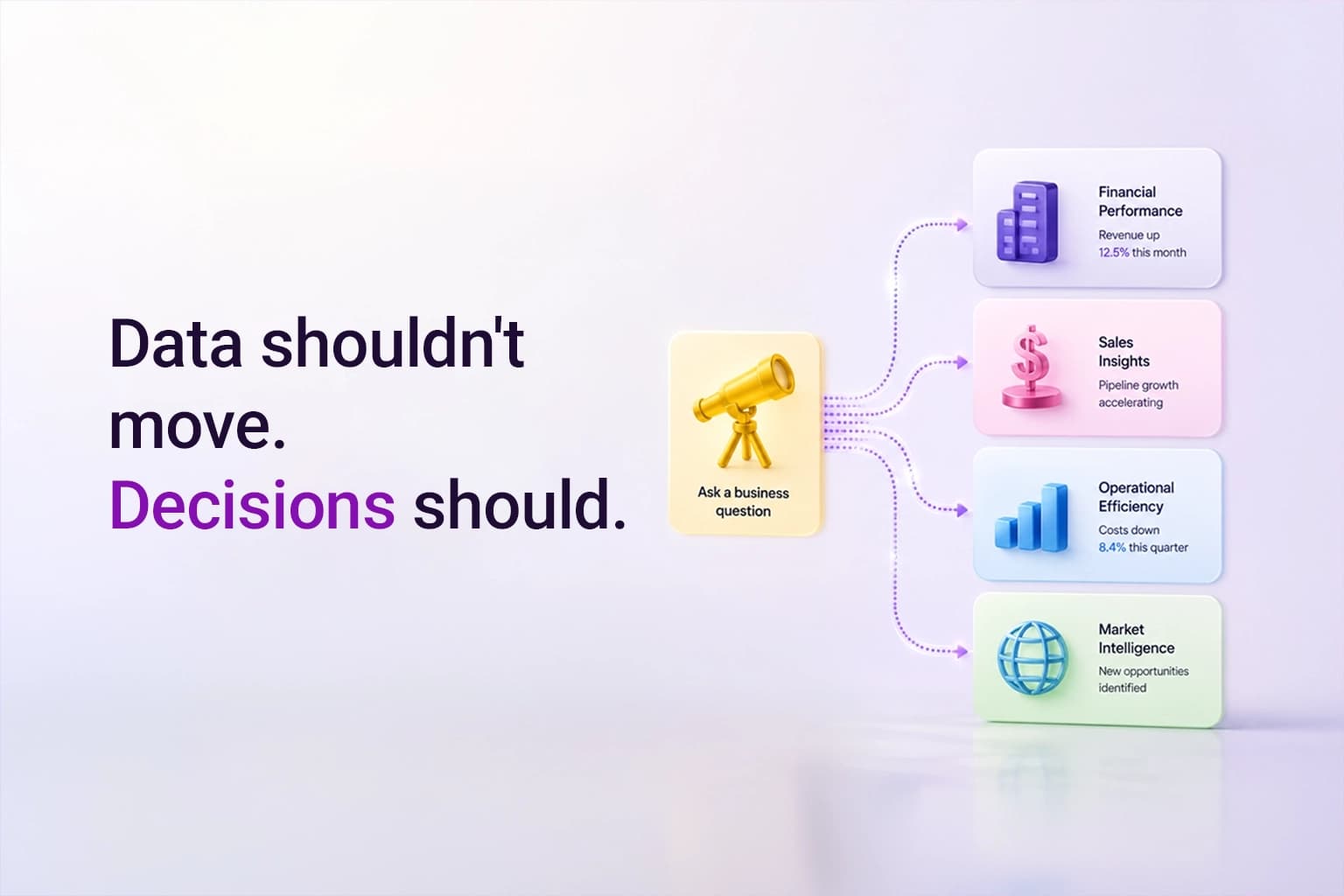
Enterprise AI projects do not fail because the models are weak. They fail because answers arrive too late. Inside modern enterprises, data already exists. Questions already exist. Yet decisions still stall. The delay lives in the space between systems, teams, and trust, and for years the default response has been to move data closer to AI. Extract it. Transform it. Copy it. Store it again.
That approach made sense at an earlier moment in the data stack’s evolution. It does not scale now, and the organisations still running it are paying a cost that rarely appears on any infrastructure budget.
Why Most AI Initiatives Slow Teams Down
On paper, the traditional model looks responsible. Data is cleaned, schemas are aligned, pipelines enforce order, and AI works on prepared datasets in controlled environments. In practice, the cost shows up somewhere else entirely.
Pipelines take months to build. Data copies multiply. Latency compounds at each handoff. Engineering becomes the gatekeeper to every new question, and business users learn to stop asking. Over time this changes behaviour in ways that are difficult to reverse. Analysts drown in repeat requests. Leaders default to instinct because the system cannot move fast enough to be useful. The problem is not intelligence. It is timing.
The Hidden Cost of Bringing Data to AI
When organisations move data to AI, they also move responsibility. Every pipeline needs maintenance. Every copy introduces risk. Every transformation creates a chance for drift. Storage costs rise quietly. Governance becomes harder because truth exists in more than one place, and proving which version is authoritative becomes its own project.
The real expense is not infrastructure. It is attention. Engineers spend their time keeping systems alive instead of improving how decisions get made. Analysts become translators instead of thinkers. Business teams wait for answers that are already stale by the time they arrive. Speed disappears without anyone noticing when it left.
What Changes When AI Goes to the Data
When AI connects directly to the systems where data already lives, the shape of work changes fundamentally. There is no extraction step. There is no shadow warehouse built to serve a single query surface. AI operates as a service layer that reads, reasons, and responds in place, and the effects are immediate: answers reflect current reality, storage duplication drops, latency shrinks, and the number of questions teams feel comfortable asking goes up rather than down.
Instead of preparing data for every possible question in advance, teams answer the questions that matter right now. AI becomes an access layer, not another destination. This is not about replacing the tools already in use. It is about activating them.
Governance Improves When Nothing Moves
The common concern about direct AI access is that it creates risk. In practice, copying data is what expands the risk surface. When AI queries systems in place, governance stays anchored to the source. Permissions remain intact. Audit trails are simpler. Compliance becomes clearer because there is one version of truth, and it has never moved.
This matters especially in regulated environments where explainability is not optional. Answers are not just faster. They are traceable. Trust becomes a property of the system rather than a promise made after the fact, which is the only kind of trust that holds up under scrutiny.
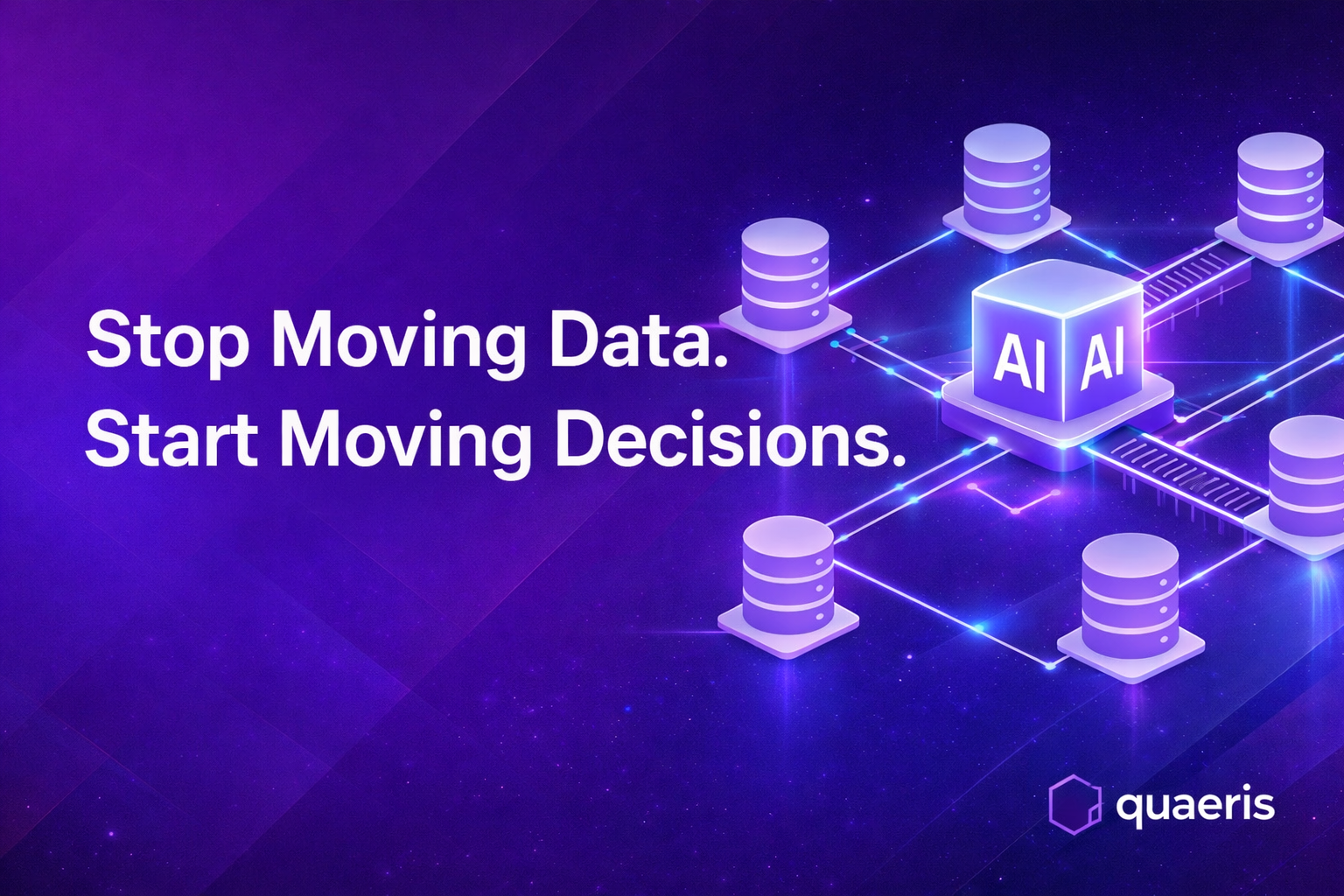
Decision Speed Is the Real Metric
Analytics teams have historically measured success in outputs: dashboards delivered, models trained, pipelines deployed. The business measures something different. It measures whether the decision arrived in time.
When AI meets data where it lives, speed changes behaviour across the organisation. Leaders ask follow-up questions instead of postponing meetings. Managers align teams faster because the numbers are not in dispute. Analysts spend more time on edge cases and less time rebuilding the same views for different stakeholders. Velocity returns, not because people work harder, but because the system stops getting in the way.
From Pipelines to Presence
The old model follows a familiar rhythm: build the pipeline, prepare the data, wait for results. The new model is structurally simpler: connect the systems, ask the question, act on the answer.
The shift is subtle but the compounding effect is significant. AI becomes present at the moment of need rather than bolted on afterward. It supports how decisions are actually made inside the organisation, not how architecture diagrams say they should be made. The gap between knowing and doing narrows, and that gap is where most enterprise momentum is currently being lost.
What This Means for Analytics Teams
This change is not about removing analysts. It is about restoring their leverage. When AI handles access and translation, analysts become the owners of semantic definitions and the stewards of data trust. They define what metrics mean. They guide interpretation. They protect quality without becoming a bottleneck to every downstream request.
The day-to-day work gets quieter. The strategic impact gets larger. Instead of managing a backlog, the team manages momentum, which is a fundamentally different and more valuable use of the skills that qualified analysts actually have.
What This Means for Leaders
For executives, the question is no longer which model is more capable. It is which model respects time. Every delayed answer carries a cost that compounds: missed windows, extra meetings, risk aversion, rework. Over time, hesitation becomes the organisational default, and reversing it requires more than a new tool.
Bringing AI to data shortens the distance between knowing and doing. It gives organisations the ability to move with confidence rather than caution, which is the condition required for decisions to actually land.
A Calmer Way Forward
The future of enterprise AI is not louder models or more dashboards. It is calmer systems. Systems that do not demand constant rebuilding. Systems that meet people where they already work. Systems that answer questions while there is still time to act on them.
When AI goes to the data, clarity arrives sooner. When clarity arrives sooner, decisions move. When decisions move, organisations recover the rhythm that slower systems took from them. That is the real advantage: not more intelligence, but less hesitation.