

First, Clear Up the Confusion: Claude and QuaerisAI Are Not the Same Kind of Thing
Claude is a foundational large language model made by Anthropic. Its job is to understand language and reason: to read a question, a document, or a block of code and produce a thoughtful response. You can use it to draft a memo, debug a Python script, summarise a contract, or work through a data problem. By most accounts in 2026, it is one of the best reasoning engines available.
QuaerisAI is a governed analytics platform. Its job is narrower and deeper: to let business users ask questions of your enterprise data and get back trustworthy, permission-aware answers, without writing SQL, exporting to spreadsheets, or filing a ticket with the data team. Under the hood it uses models like Claude, but it wraps them in the scaffolding that makes analytics safe at scale: a semantic layer, access controls, read-only execution, and an audit log.
Put simply: Claude is the intelligence. QuaerisAI is the governed system that puts that intelligence to work on regulated, production data. That single distinction explains every meaningful difference below, and it is why the most accurate answer to “Quaeris or Claude?” is frequently “Quaeris, running on Claude.”
What Claude Is Genuinely Good At
It is worth being generous and specific here, because Claude’s strengths are real and a fair comparison demands them.
Claude is excellent at open-ended reasoning and synthesis: the kind of multi-step thinking that connects a chart, a paragraph of context, and a business question into a coherent answer. It writes and debugs SQL and Python fluently, leaning on the standard analyst toolkit (pandas, NumPy, matplotlib, seaborn, plotly), and it explains the reasoning behind its output, not just the code. For exploratory data analysis, summarising long documents, and drafting the narrative around a finding, it is hard to beat.
The surrounding product surface has matured fast. Claude Cowork connects to your desktop, reads and writes files, and can run long or background analyses while you do something else. Agent Skills, which are reusable instruction folders, let Claude load a saved EDA checklist or data-cleaning routine on demand, and they work across Claude.ai, Claude Code, and the API. Through the Model Context Protocol (MCP), Claude can connect to live databases like Postgres, BigQuery, and Snowflake, to notebooks, and to enterprise systems.
Anthropic has also pushed into regulated workflows. It launched Claude for Financial Services with agent templates, MCP connectors to data providers including FactSet, S&P Capital IQ, PitchBook, Morningstar, and MSCI, Microsoft 365 add-ins for Excel, PowerPoint, and Word, and enterprise controls including SSO, SCIM, audit logs, custom data retention, and ISO/IEC 42001:2023 certification, alongside a commitment not to train on enterprise customer data. For technical users who can verify outputs, this is a capable analysis companion.
None of that is in dispute. The question is what happens when you hand a model like this your messy, regulated, multi-thousand-column production warehouse and ask non-technical people to trust the answers.
Where a Raw Model Hits Its Limits on Enterprise Data
Here is the gap that governed platforms exist to close.
Accuracy collapses on real schemas. On the clean academic benchmark Spider, top text-to-SQL approaches reach roughly 88% execution accuracy. But when researchers rebuilt those benchmarks to look like actual enterprise databases, with wide tables, cryptic column names, and domain knowledge scattered across documents, accuracy fell sharply. Research on enterprise text-to-SQL benchmarks reports state-of-the-art models scoring around 39% on the enterprise-style BIRD-Ent set and roughly 60% on Spider-Ent. You should verify these figures against the primary research before citing them publicly, as benchmark results in this area are updated frequently. A tidy demo tells you almost nothing about how a model behaves on your warehouse. The danger is not an obvious error. It is a confidently wrong number that looks plausible and gets acted on.
Governance is not innate to the model. This is the subtle part. When you read about Claude querying Snowflake or Databricks safely, look closely at where the safety lives. In the documented governed Snowflake-via-Claude pattern, the model is deliberately constrained to a text-to-SQL tool that runs through a semantic view, with no ability to execute arbitrary SQL. The role permissions, the semantic view, and the agent’s tool list are the governance layers, not the model itself. Databricks examples lean on Genie Spaces acting as a defined semantic layer. In every case, the row-level security, identity propagation, read-only execution, and metric definitions come from the surrounding system, not from the model. A raw model will generate DROP TABLE if its tools allow it. It respects a rule only if something underneath enforces it.
There is a new attack surface too. Just as classic applications faced SQL injection, conversational systems face prompt injection, what Cisco’s security team has described as the new SQL injection, noting you cannot parameterise a prompt the way you parameterise a query. In an agent that can execute queries autonomously, that becomes a code-execution risk.
The point is not that Claude is unsafe. It is that safety on enterprise data is a property of the system you build around the model. You can assemble that scaffolding yourself with semantic views, scoped tools, and read-only connections. Or you can use a platform where it is already built in. That platform is what QuaerisAI is.
What QuaerisAI Adds: The Governed Layer Around the Intelligence
QuaerisAI is, in effect, the production-grade scaffolding from the previous section turned into a product, with a few capabilities most teams could not easily build themselves.
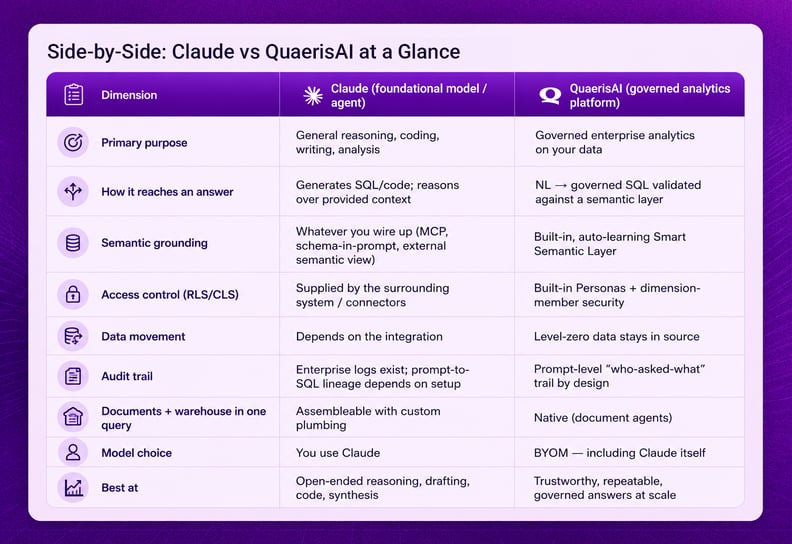
A smart semantic layer that learns. Most semantic layers require an upfront modelling sprint, authoring LookML, MDX, or dbt metrics before anyone gets an answer. QuaerisAI’s Smart Semantic Layer automatically learns business definitions and data relationships from how people actually query, so questions resolve against governed definitions instead of being guessed fresh each time. That is the difference between deterministic answers and probabilistic ones. The same metric returns the same result every time, regardless of who asks or how they phrase the question.
Conversational queries to governed SQL. QuaerisAI translates questions asked in everyday language into SQL that is checked against the semantic layer rather than free-form generated, then executed against a read-only path, directly addressing the accuracy and safety gaps that affect raw models.
Governance that the database enforces, not the prompt. QuaerisAI applies two-tier control: Personas for functional access plus granular data security down to each individual dimension member, with row- and column-level rules. It never moves level-zero data out of the source, eliminating an entire class of exposure and residency risk.
A prompt-level audit trail. QuaerisAI logs the question asked, the generated query, the user, and the result: a who-asked-what lineage that matters more every quarter as the EU AI Act and SOX expand to cover AI agents.
Documents and the warehouse in one question. Through its document agents, QuaerisAI answers a question like “Show me last quarter’s churned enterprise accounts and summarise the cancellation reasons” across structured tables and unstructured contracts, tickets, and PDFs, with source citations, version control, and folder-level access, in a single governed query. Roughly 80% of enterprise data is unstructured (per IDC’s widely cited projection, which you should verify against current IDC publications). Unifying both halves is something a chat interface can assemble only with significant custom engineering.
Trusted agents that act. QuaerisAI’s autonomous multi-step agents do not just answer. They plan and execute analyses (forecast, anomaly-detect, root-cause) and can route action into systems like SAP or MRP, surfacing issues before they reach the business.
Side-by-Side: Claude vs. Quaeris AI at a Glance
The Twist: You Can Run Claude Inside QuaerisAI (BYOM)
This is the detail that reframes the entire comparison. QuaerisAI is bring-your-own-model: you connect OpenAI, Anthropic (Claude), Google, or Meta, and switch as the model landscape shifts, without re-platforming and with no training on your data.
So “QuaerisAI vs Claude” is, for many buyers, a false binary. You do not have to choose between Claude’s reasoning and enterprise governance. BYOM lets you keep Claude as the engine and gain QuaerisAI’s semantic layer, access controls, and audit trail around it. When a better model ships next quarter, you switch the engine and keep every governed definition intact. Model leadership changes often. Your governance should not have to change with it.
The honest caveat that applies to every option: a conversational interface dropped onto ungoverned data does not make the data governed. It just makes the gaps easier to reach. The technology amplifies whatever governance posture you already have. QuaerisAI’s value is supplying that posture so the speed does not come with a hidden compliance cost.
Why QuaerisAI Produces More Reliable Results
QuaerisAI was built around a simple thesis: the model should do what models are good at, understanding the question and phrasing the answer, while the math stays governed. That is why the Smart Semantic Layer learns your definitions automatically, why questions become governed SQL instead of free-form guesses, and why permissions are enforced by the platform rather than requested of the prompt.
The result is adoption without a rebuild. In one deployment layered on an existing Power BI model, QuaerisAI drove a roughly 400% lift in data interaction, not by replacing the warehouse or re-modelling everything, but by making trustworthy answers easy to ask for. This figure is from QuaerisAI’s published customer materials; attribute accordingly. Pair that with BYOM, and you get the best of both worlds: frontier reasoning from a model like Claude, inside a system your security, compliance, and finance teams can actually approve.
If you want to see governed agentic analytics, optionally powered by Claude, running on your own data, book a demo.
Frequently Asked Questions
Is QuaerisAI a competitor to Claude, or does it use Claude?
Both, depending on how you look at it. QuaerisAI competes with the idea of using a raw model as your analytics layer, but it also supports Claude as a bring-your-own-model option. Many customers run Claude as the engine inside QuaerisAI’s governed platform.
Can Claude query my data warehouse directly?
Yes, through connectors and the Model Context Protocol, Claude can connect to databases like Postgres, BigQuery, and Snowflake. The caveat is governance: the access controls, semantic grounding, and read-only enforcement come from the surrounding system you configure, not from the model itself.
Does Claude return wrong numbers on enterprise data?
Like any large language model, it can, especially on real enterprise schemas. Benchmark research suggests text-to-SQL accuracy can drop significantly from clean academic datasets to real enterprise schemas. That is why governed platforms validate generated queries against a semantic layer rather than relying on free-form generation.
What does QuaerisAI add that Claude alone does not?
An auto-learning semantic layer, question-to-governed-SQL translation, row- and column-level security with Personas, no level-zero data movement, a prompt-level audit trail, and unified querying across documents and the warehouse, all built in rather than assembled.
Can I switch the model QuaerisAI uses?
Yes. QuaerisAI is bring-your-own-model: connect OpenAI, Anthropic (Claude), Google, or Meta, and switch as the landscape evolves without rebuilding your governed definitions.
Is my data used to train the model?
QuaerisAI does not train on customer data. Anthropic’s enterprise offering also carries a no-training-on-customer-data commitment. Always confirm the specific terms for your deployment before going live.
Which is better for regulated industries like finance, insurance, or healthcare?
For regulated data accessed by many users, a governed platform like QuaerisAI is the safer production path because access control and auditability are enforced by the system. Claude can serve as the reasoning engine within that platform via BYOM.
Can I query documents and databases together?
Yes. That is a core QuaerisAI capability. A single question can pull structured figures from the warehouse and summarise related unstructured documents, returning one cited, governed answer.