Agentic BI, short for agentic business intelligence, uses AI agents to plan and carry out multi-step analysis toward a business goal. An agent can select tools, query authorized data, examine results, and adjust its investigation without requiring a person to direct every step.
Key takeaways
Agentic BI is defined by an investigation that adapts as evidence emerges, not by a chat interface.
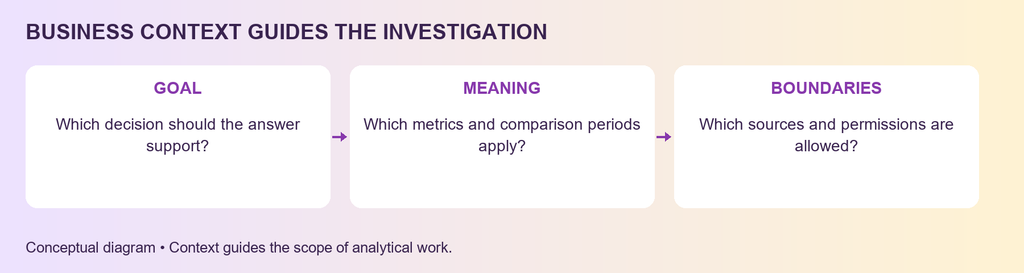
Useful autonomy starts with business context: shared metric definitions, operating conditions, and access rules.
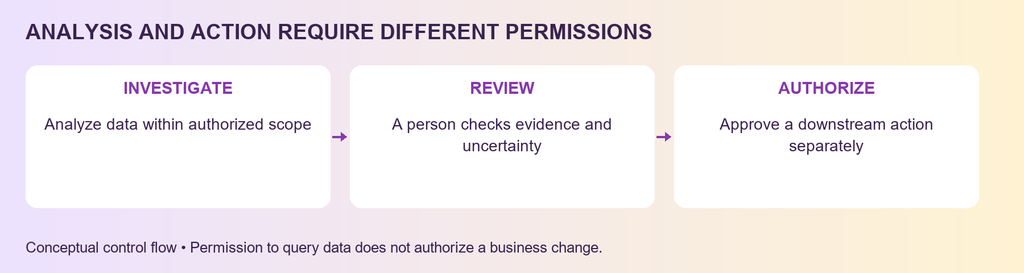
Analyzing data and acting on it are separate permissions. A trustworthy answer shows its evidence and leaves the decision to a person.
Agentic BI applies the broader concept of agentic analytics to business reporting, investigation, and decision support. The defining capability is an investigation that adapts as evidence emerges.
Quaeris’s perspective is straightforward: useful autonomy starts with business context. An agent needs to understand the question, the organization’s definitions, and the information the user is allowed to access. That foundation helps turn an answer into something a team can examine and use.
Why agentic BI matters
A loyalty manager sees that coupon redemptions fell in several stores. The dashboard reveals the change, but the next decision depends on understanding it.
Were promoted products unavailable? Did fewer customers qualify? Did the campaign start late?
Each possibility requires another comparison. When every follow-up becomes a separate report request, the investigation can outlast the promotion.
Agentic BI can reduce these handoffs by coordinating related analytical steps. Business teams gain a faster way to investigate approved data, while analysts can spend more time on complex interpretation, experimentation, and measurement.
How agentic BI works
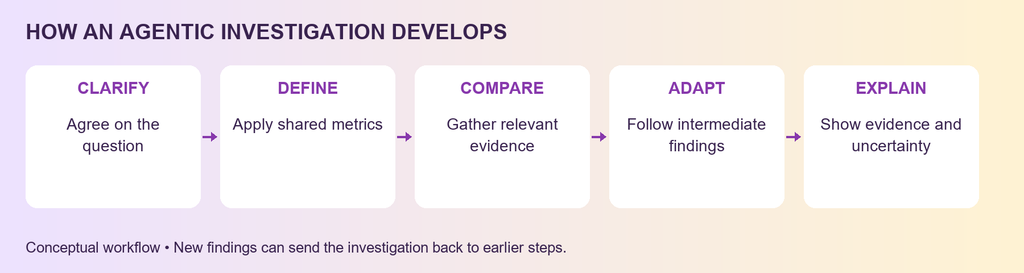
An agentic investigation follows a loop: establish the goal, gather evidence, analyze it, and decide what to examine next. Intermediate findings shape the next step.
Consider an illustrative request: “Why did coupon redemptions decline in our northern stores?”
Clarify the question. Establish the campaign, stores, comparison period, and whether the manager means redemption volume or redemption rate.
Apply business definitions. Use the agreed calculation and eligible customer population.
Investigate relevant data. Compare store performance, product availability, campaign timing, and eligibility records.
Follow the evidence. If the decline is concentrated in stores with inventory gaps, examine those stores more closely.
Present a reviewable finding. Explain the pattern, show supporting comparisons, and identify what remains unresolved.
An observed relationship can justify further investigation. Establishing that stock shortages caused the decline may require additional evidence or a controlled test.
Agentic BI vs traditional BI and other analytics
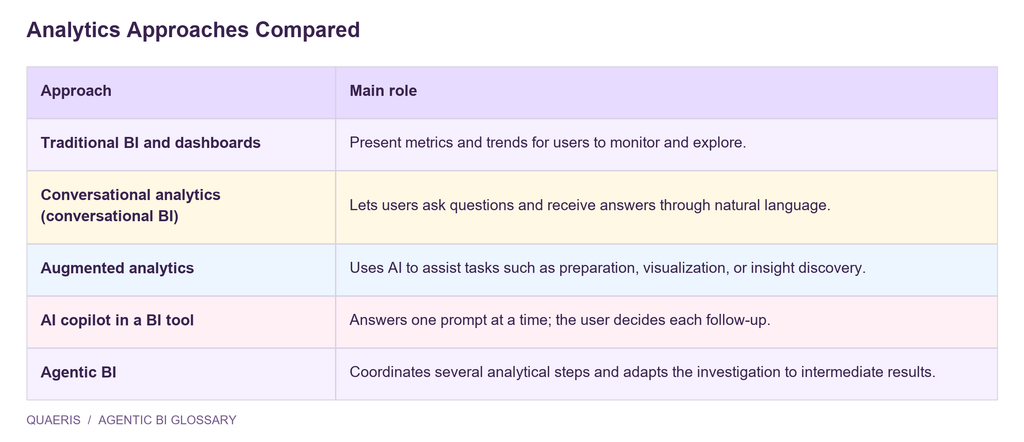
These capabilities can coexist in one platform. A conversational interface can support an agentic workflow; the distinction is how the analytical work happens behind it.
Why business context matters
The same number can support different decisions depending on the situation.
A lower redemption rate could reflect stricter eligibility rules. Higher promotional revenue could conceal weaker margins. A comparison could be misleading if one campaign ran for fewer days.
Useful context includes:
Metric definitions: How the business calculates revenue, redemption, or margin.
Operating conditions: Timing, availability, customer eligibility, and relevant policies.
Decision objectives: Whether the team is optimizing growth, profitability, retention, or another outcome.
Data freshness: Whether the records cover the period being investigated.
A semantic layer provides shared definitions and relationships that agents can use consistently. Quaeris’s Smart Semantic Layer supports metric certification, ownership, and versioning, with data teams reviewing proposed definitions.
What should a trustworthy answer show?
A useful answer gives the reader enough evidence to check its meaning and decide what comes next:
The metric definition and comparison period.
The sources and filters used.
The analytical steps supporting the finding.
Missing information or unresolved interpretations.
A proposed next step and the person responsible for reviewing it.
Access controls determine what the agent may retrieve. Audit records help teams reconstruct what happened. These controls matter throughout the investigation, especially when several tools or datasets are involved.
Analyzing a campaign and changing its budget are separate permissions. Any downstream action needs an explicitly authorized workflow and appropriate approval rules.
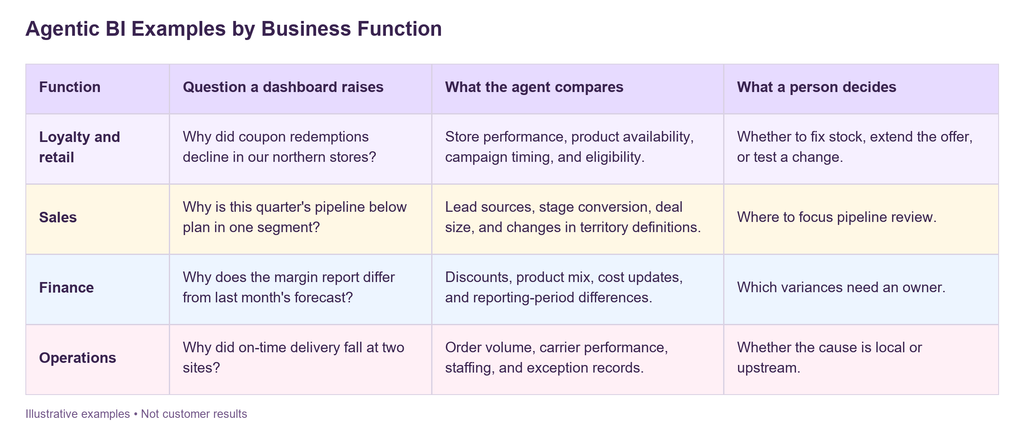
Agentic BI examples by business function
These examples are illustrative. They show questions that need several connected steps, not Quaeris customer results.
How Quaeris approaches agentic BI
Quaeris connects natural-language questions with multi-step analysis, governed metric definitions, and traceable results. Its published platform capabilities include role-based access controls enforced at query time and logs of questions, agent activity, and answers.
For business users, this supports exploration using shared definitions. For data teams, it provides a foundation for managing access and reviewing how answers were produced. Explore the Quaeris platform.
Start with one question: a practical pilot
Choose a recurring investigation that currently creates reporting delays. Promotion performance, sales variance, or an operational exception can provide a focused starting point.
Define the decision. Identify who will use the answer and what decision it should support.
Prepare the context. Agree on metrics, sources, comparison periods, access permissions, and a business owner.
Create a reference set. Have an analyst validate representative questions, including ambiguous requests and cases with incomplete data.
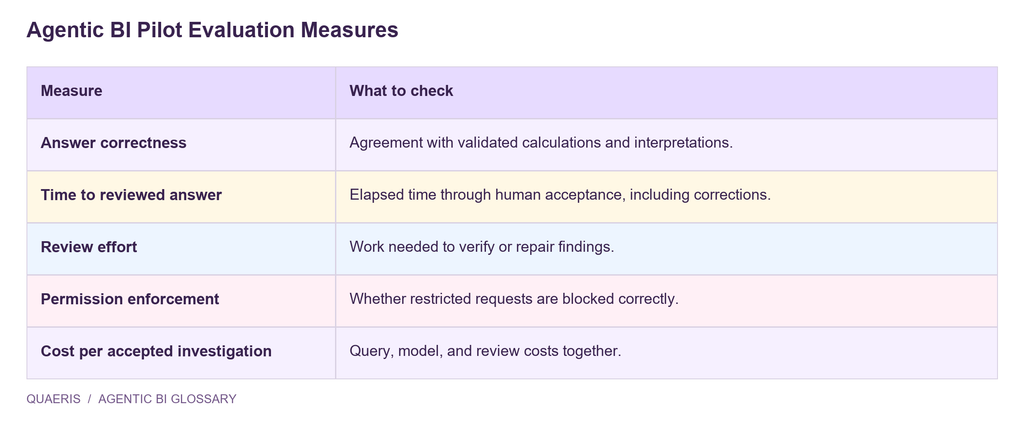
Measure performance.
Set acceptance criteria before the pilot. Review failures, improve definitions or workflows, and expand the scope when results justify it. Known-answer testing, latency, and cost tracking are established evaluation practices for multi-step agents.
For a fuller list of evaluation measures, see the Quaeris glossary entry on agentic analytics.
Related terms
Agentic analytics: The broader practice of using AI agents for multi-step data analysis. Agentic BI is its application to business reporting and decision support.
Conversational BI: Asking BI questions in everyday language, also called natural language BI. It describes the interface.
Generative BI: Using generative AI to produce queries, charts, or summaries from a prompt.
Augmented analytics: AI assistance for preparation, visualization, or insight discovery, with a person directing the analysis.
Semantic layer: Shared business definitions and relationships that sit between raw data and the tools that query it.
Role-based access control: Rules that limit what data each user, and any agent acting for them, may retrieve.
Frequently asked questions
Is agentic BI the same as agentic analytics?
They overlap. Agentic analytics is the broader term for AI agents carrying out multi-step data analysis. Agentic BI usually refers to the same approach applied to business reporting, dashboards, and decision support.
Does agentic BI replace dashboards?
Dashboards remain useful for recurring monitoring. Agentic BI adds a way to investigate questions that require several connected steps. Often a dashboard raises the question and the agent investigates it.
How is agentic BI different from an AI chatbot in a BI tool?
A chatbot or copilot typically answers one prompt at a time and leaves each follow-up to the user. Agentic BI plans several steps and uses intermediate results to decide what to examine next.
Does agentic BI replace analysts?
Analysts remain responsible for measurement design, complex interpretation, and validation. Agents can assist with repeatable investigative work.
Does agentic BI need a semantic layer?
It needs consistent business definitions. A semantic layer is a common way to provide them, so that an agent calculates revenue or redemption the same way each time.
Does “agentic” mean fully autonomous?
Autonomy varies by workflow. A system may investigate independently while requiring approval before changing an external system.
What are the limits of agentic BI?
An agent can only work with the data and definitions it is given, and a pattern it finds does not prove a cause. Important findings still need review, and some questions need a controlled test.
Where should a business begin?
Start with one recurring question, clear definitions, and a measurable pilot. Bring that question to aQuaeris demo to explore the workflow against your requirements.