Agentic analytics uses AI agents to investigate business questions through multiple analytical steps. Within defined permissions, an agent can plan an investigation, query relevant data, check intermediate results and refine its approach. The output should give people evidence they can verify and a practical next step they can evaluate.
For a business team, the useful question is: Can we trace the finding to reliable data, understand its limitations and decide what to do next?
Key takeaways
Agentic analytics is defined by how the work is done: an AI agent plans and adapts a multistep investigation instead of answering a single query.
A trustworthy result comes with an evidence record: sources, definitions, calculations, checks and limitations.
Permission to analyze data is separate from permission to act on it. People set the objectives and approve consequential changes.
What is agentic analytics?
Agentic analytics is an approach to data analysis in which AI agents carry out a sequence of tasks toward an analytical goal, adjusting their approach as they gather evidence. It is sometimes called agentic BI or agentic business intelligence.
The agent doing the work is often called an analytics agent: an AI system that can use approved tools, such as queries and calculations, to work through a data question step by step.
A user might ask, “Why did customer conversion decline last month?” The agent could compare conversion rates, examine customer segments, check for tracking changes and investigate where the decline is concentrated.
A useful response identifies:
What changed and which groups were affected.
Which data, definitions and calculations support the finding.
What explanations were checked.
What remains uncertain.
What investigation, test or action should follow.
The agent’s ability to investigate does not automatically authorize it to change a campaign, contact customers or update a business system. Those actions require their own permissions.
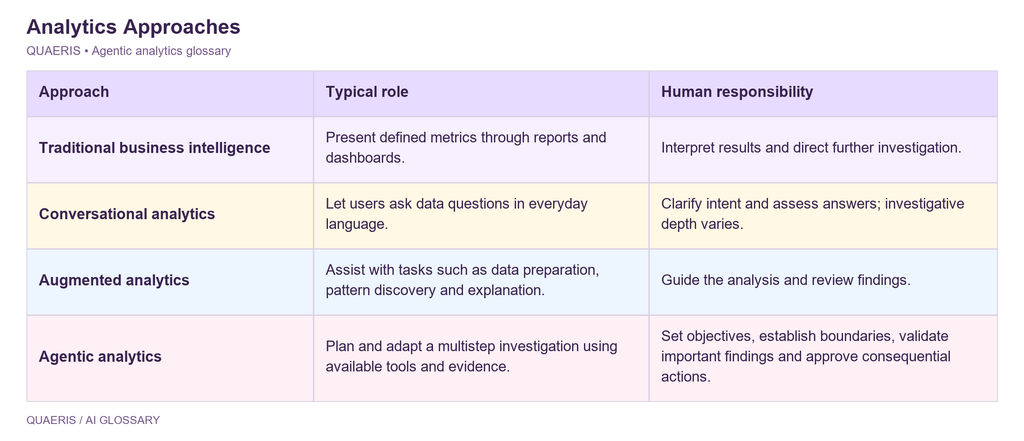
Agentic analytics vs traditional BI, conversational analytics and augmented analytics
These categories overlap, and individual products vary. The distinction is how much of the analytical process the system can carry out and adapt.
Conversational analytics describes how people interact with a system. Agentic analytics describes how the system performs work. A platform can support both.
The benefits depend on data quality, clear definitions and review. Where those are in place, agentic analytics can help with:
Less manual investigation: The agent carries out the repetitive comparisons an analyst would otherwise run by hand.
Faster follow-up questions: Each intermediate finding shapes the next step without waiting for a new request.
More consistent method: The same checks and evidence record can be applied to every investigation.
None of these is automatic. The evaluation section below describes how to test whether they hold in your environment.
How agentic analytics works
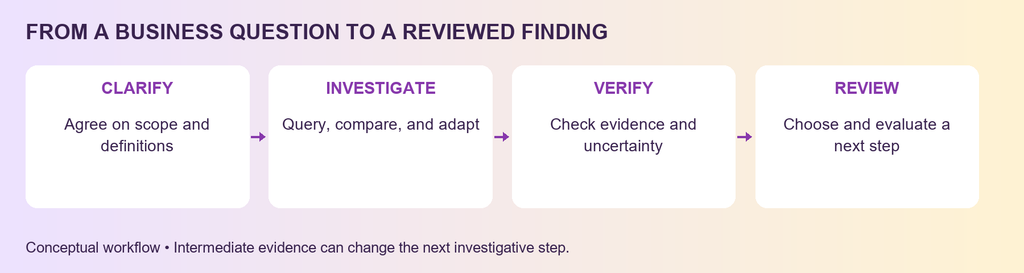
A verifiable investigation follows a repeatable process.
1. Clarify the business question
Start with a decision someone needs to make.
“Analyze our sales” is too broad. “Investigate why net revenue declined last month and identify which changes need attention” provides a clearer objective.
The agent should clarify ambiguous terms, reporting periods and comparison groups before proceeding.
2. Establish the data and definitions
Confirm the meaning of the measures involved.
For revenue, that could include whether the calculation accounts for refunds, discounts, taxes and currency conversion. For conversion, it includes the eligible population and the time allowed to convert.
Many teams hold these definitions in a semantic layer, a shared set of business definitions that sits between raw data and the tools that query it.
Check data freshness, completeness and access permissions. An agent should flag unresolved definitions instead of silently choosing one.
3. Plan and run the investigation
The agent breaks the question into smaller tasks, such as comparing periods, examining segments and testing alternative explanations.
Intermediate findings determine what to investigate next. A decline concentrated in one acquisition channel calls for different follow-up questions than a decline across every channel.
4. Check the evidence
A query that runs successfully can still answer the wrong question.
Useful checks include reconciling totals with an approved report, reviewing joins and filters, checking missing records and recalculating important results independently.
An observed relationship can suggest an explanation. It does not, by itself, establish causation.
5. Report findings and uncertainty
The response should distinguish verified observations from hypotheses.
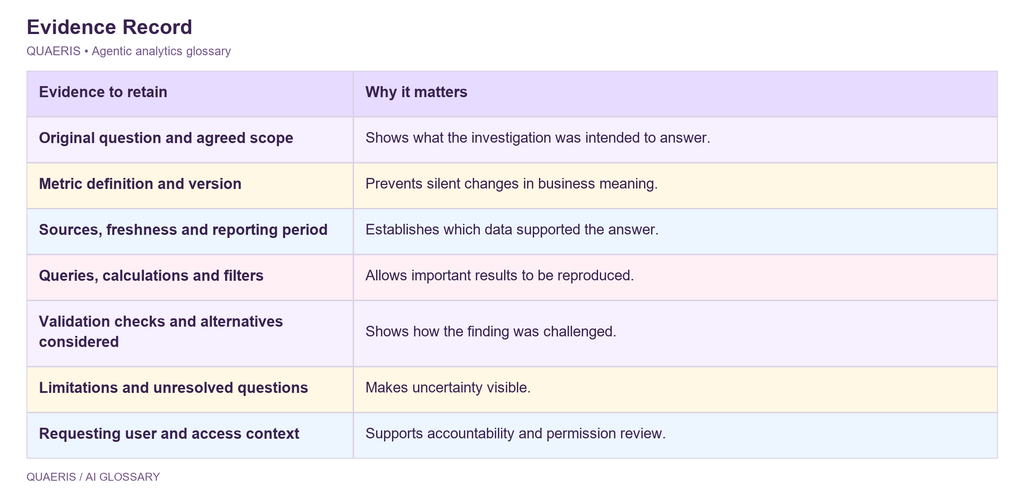
It should also provide an evidence record: data sources, reporting period, metric definitions, query or calculation references, relevant filters and unresolved limitations.
6. Choose and evaluate the next step
A person reviews the finding and decides whether to investigate further, run a limited test or approve a change.
Assign an owner, define success and set a review date. Measure what happens after the response rather than assuming that producing an insight created value.
Conceptual summary of the investigation and review process.
Example of an agentic analytics investigation
The following example is fictional and illustrates a workflow, not a Quaeris customer result.
Business question: Why did trial-to-paid conversion decline, and what should the product team investigate?
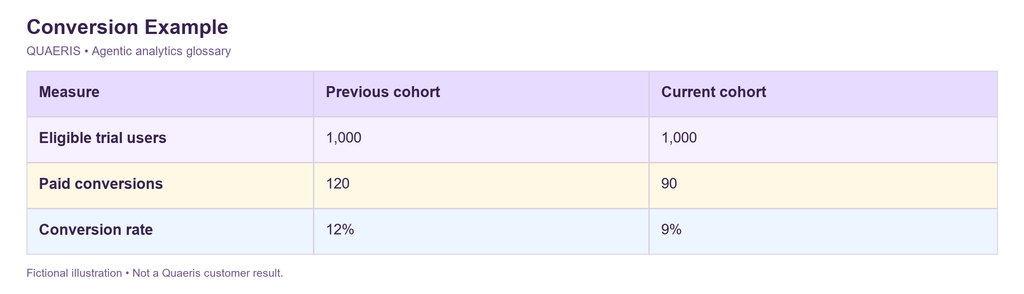
Two trial cohorts have each completed the same 30-day conversion window.
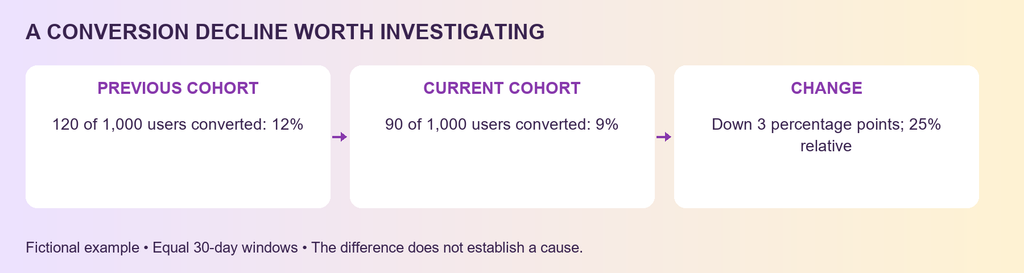
Conversion fell by 3 percentage points, or 25% relative to the previous rate.
The agent checks whether eligibility rules or tracking changed, then compares acquisition channels, plans and onboarding completion. It finds that the decline is concentrated among users who did not complete setup.
That finding supports further investigation. It does not prove that incomplete setup caused the decline; changes in customer mix or product experience could influence both measures.
Proposed next step: The product growth manager reviews the evidence and approves a limited onboarding-assistance test.
Measurement plan: Define the eligible population, comparison group, sample requirements and review period before launching. Track paid conversion alongside support effort, cancellations and customer complaints.
Decision after the test: Expand, revise or stop the intervention based on the results and their uncertainty.
This connects a business question to evidence, an accountable decision and a measurable response.
The fictional cohort comparison above, visualized.
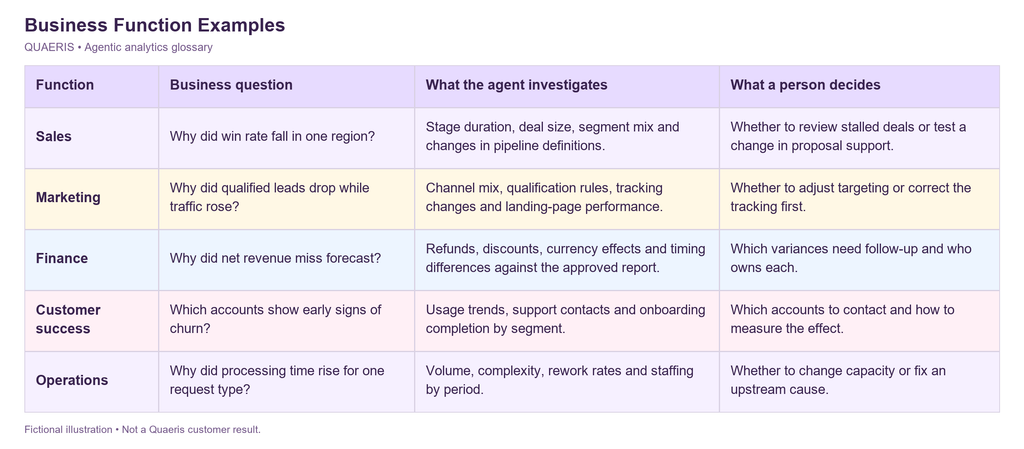
Agentic analytics examples by business function
These examples are illustrative. They show the kind of question that suits a multistep investigation, not Quaeris customer results.
What makes an investigation verifiable?
A reader should be able to check how the system reached its conclusion.
Source citations help readers locate evidence. They do not guarantee that the calculation or interpretation is correct.
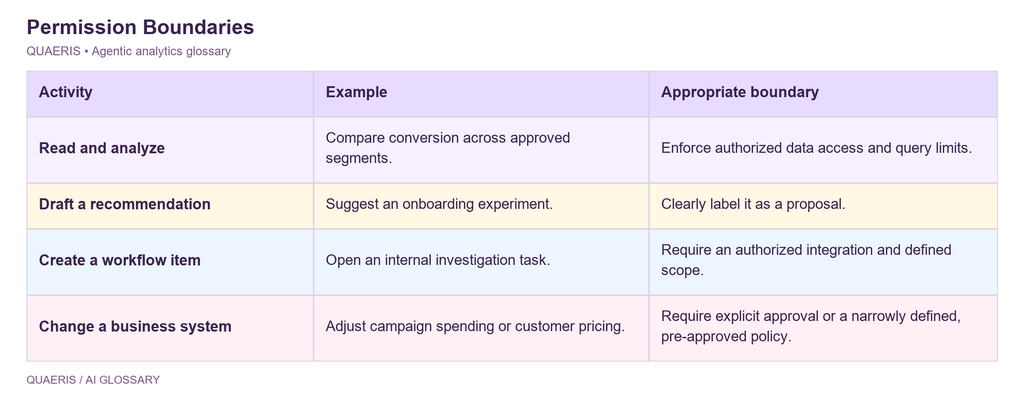
How much should an analytics agent be allowed to do?
Set permissions according to the consequences of the action, and keep a human in the loop for anything consequential.
For embedded or white-label analytics, also verify which customer’s data the agent can access and whose permissions apply. Branding should never obscure responsibility for access, approval or support.
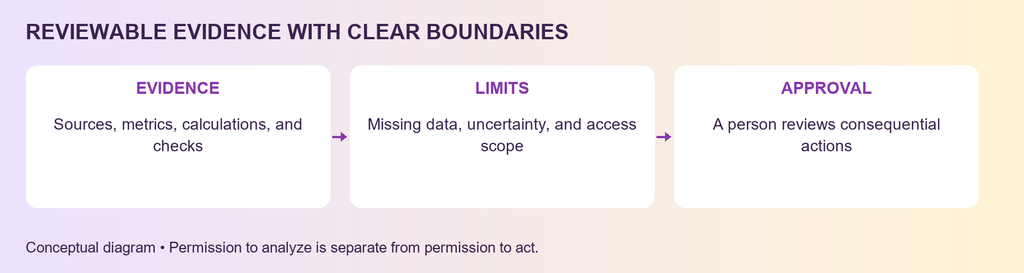
Evidence review and action permissions are complementary controls.
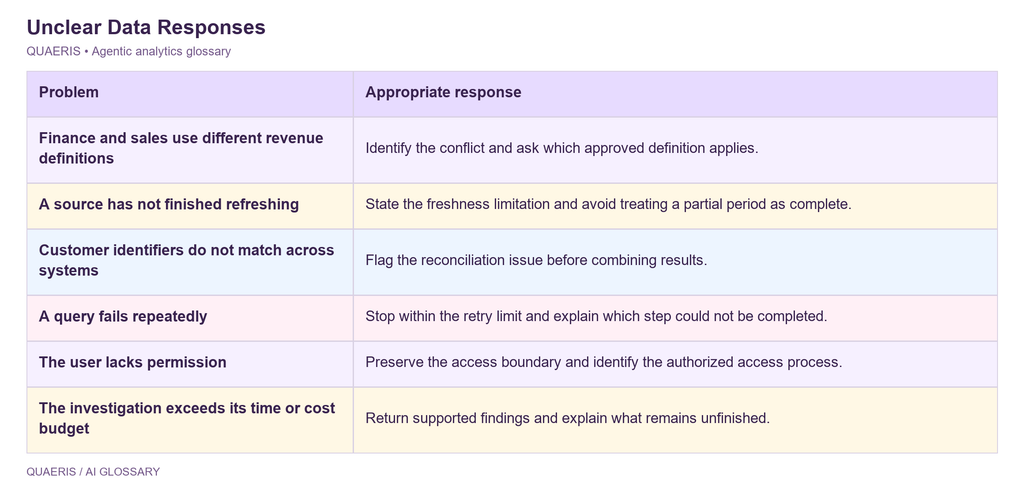
What happens when the data is unclear?
A trustworthy workflow includes a way to pause, ask for clarification or escalate.
“Insufficient evidence” can be the correct analytical result.
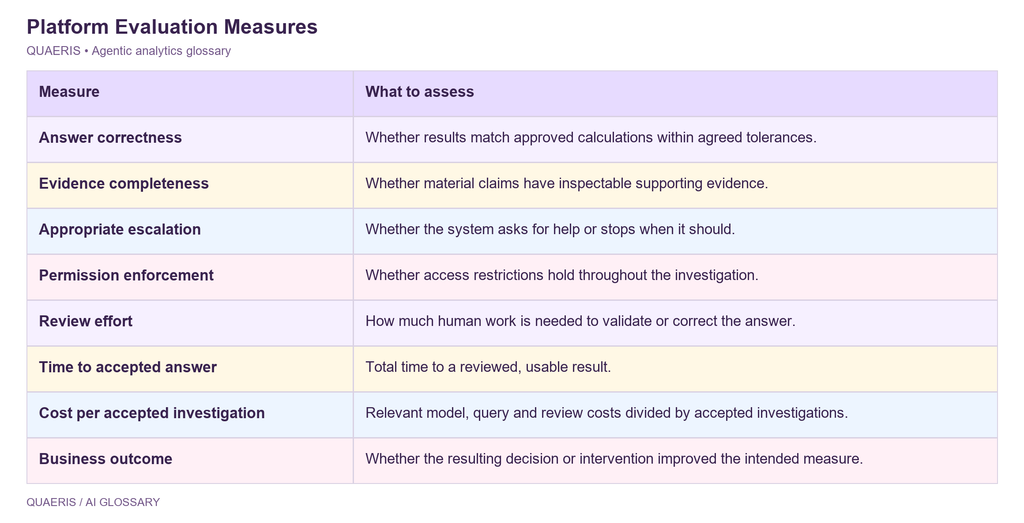
How to evaluate an agentic analytics platform
Whichever agentic analytics tools you are comparing, begin with a narrow use case and representative questions whose answers can be checked. Include ambiguous questions, incomplete data and permission-sensitive requests alongside straightforward tasks.
Set acceptance criteria before the pilot. Recheck performance after changes to models, metric definitions, data sources or permissions.
A confidence label should not be treated as a measured probability unless its meaning and calibration have been established.
Getting started with a focused pilot
Choose a recurring question with an identifiable owner and accessible evidence. Agree on the metric definitions, approved sources and current manual baseline.
Begin with read-only investigation. Test the answers, document failures and establish review responsibilities. Expand access or automation only when the results support doing so.
A useful pilot brief records:
Business question and decision owner.
Approved metrics and data sources.
Permitted tools and actions.
Test questions and expected results.
Acceptance criteria and escalation rules.
Cost limits and review date.
When a simpler tool is sufficient
A dashboard is often appropriate for monitoring an established KPI. A direct query can answer a well-defined lookup. A scheduled report can serve a predictable reporting need.
Agentic analytics is most useful when the question requires several steps, the next step depends on the evidence, or repeated investigation creates substantial manual work.
It also does not remove the need for statistical expertise, experimental design or human judgment on consequential decisions.
Related terms
Analytics agent: An AI system that uses approved tools to work through a data question in several steps.
Agentic AI: The broader category of AI systems that plan and take steps toward a goal. Agentic analytics applies it to data analysis.
Conversational analytics: Asking data questions in everyday language. It describes the interface, not the depth of investigation.
Augmented analytics: AI assistance for tasks such as data preparation, pattern discovery and explanation, with a person directing the analysis.
Semantic layer: A shared set of business definitions that sits between raw data and the tools that query it.
Human-in-the-loop: A design in which a person reviews or approves defined steps before the system proceeds.
Actionable insights: Findings from data connected to a practical next step. They are the intended output of an agentic analytics investigation.
Frequently asked questions
What is an analytics agent?
An analytics agent is an AI system that can plan and carry out several analysis steps toward a question, using approved tools such as queries and calculations. AI agents for data analysis work within the data access and permissions they are given.
What is the difference between agentic analytics and augmented analytics?
Augmented analytics assists a person who is directing the analysis, for example by suggesting patterns or explanations. Agentic analytics plans and adapts the investigation itself, while people set the objective, review the evidence and approve consequential actions.
Is agentic analytics the same as agentic AI?
No. Agentic AI is the broader term for AI systems that plan and take steps toward a goal. Agentic analytics is its application to investigating business data.
Does agentic analytics replace data analysts?
It can automate parts of investigation and reporting. Analysts remain important for defining metrics, evaluating methods, designing experiments and interpreting ambiguous findings.
Does agentic analytics require a semantic layer?
It requires reliable business context and consistent definitions. A semantic layer is one way to provide them. The implementation depends on the platform and data environment; connecting to a source does not automatically resolve its business meaning.
Can agentic analytics identify root causes?
It can investigate potential drivers and test explanations against available data, which is sometimes described as automated root cause analysis. Establishing causation may require additional evidence, a suitable study design or an experiment.
What are the risks of agentic analytics?
The main risks are answers built on inconsistent definitions or incomplete data, conclusions that cannot be traced to evidence, and agents acting beyond their intended permissions. Evidence records, access controls, escalation rules and human approval for consequential actions address each of these.
Is agentic analytics always real time?
No. Freshness depends on source updates, integrations and execution schedules. The data needs to be timely enough for the decision being supported.
Can an agent act automatically?
Only within its configured tools, permissions and approval rules. Permission to analyze data should be distinguished from permission to execute a business change.
From a business question to a measurable next step with Quaeris
For teams exploring Quaeris, start with one question that matters to the business. Define what a correct answer would look like, which evidence must support it and who will decide what happens next.
Use that question to evaluate the complete workflow: investigation, verification, approval and outcome measurement.